How a Family-Run Shading Specialist Moved From Chasing Problems to Protecting the Dream
Steve and Chris Gargett already believed in content. Here's what happened when they stopped trying to do it all themselves and handed the Knowledge Centre to someone who'd built one before.
Client:
WindowTreat
Project
Knowledge Centre + 30x Big 5 Articles + 8x Core Topic Ultimate Guides + AI Digital Twin + 60 photos + 30 Article Summary Videos
Written by Mark Reynolds, The Knowledge Centre Guy
At a Glance
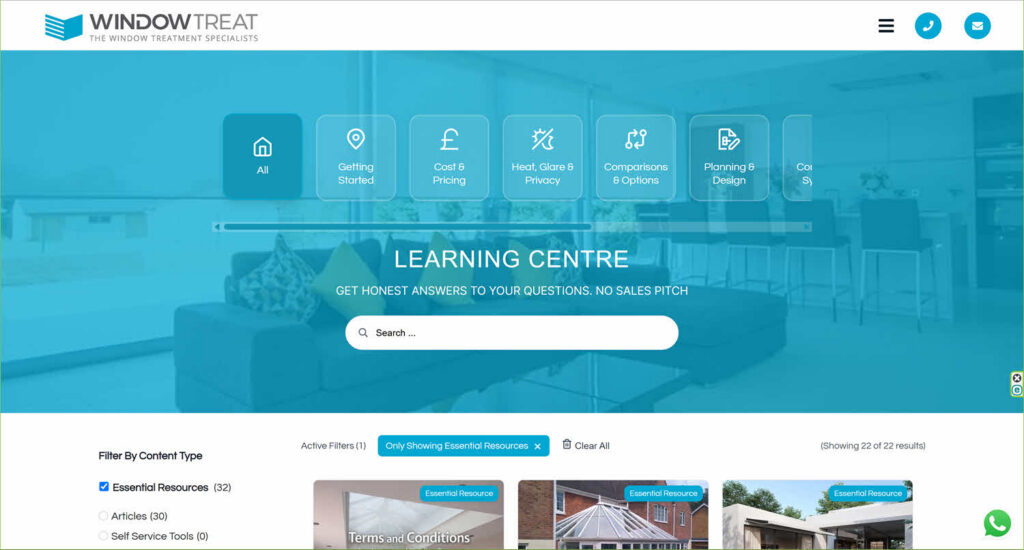
When you visit the WindowTreat Knowledge Centre you may see some articles written by Chris & Steve and some written by me – The Knowledge Centre Guy. To save you time digging around, here are links below to some of the almost 40 articles I wrote.
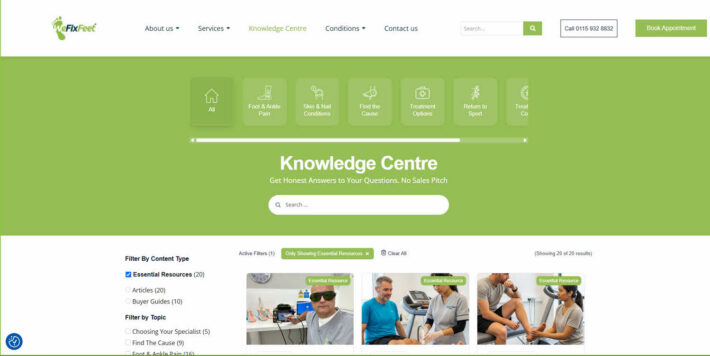
When we published their Knowledge Centre I had written 9 core topic articles which are located along the top of the Knowledge Centre PLUS approximately 30 Big 5 topic articles PLUS a critical in-depth author article which is so important for credibility, and Google/AI powered search loves them.
Big 5 Topic Articles:
Author article:
Core Topic Articles:
- Getting Started – Core Topic page that links to related articles.
- Costs & Pricing – one of the most popular Core Topic pages – (You can see the other core topic pages across the top of the Knowledge Centre in that scrollable area).
| Company | WindowTreat |
| Who led it | Steve and Chris Gargett (founders), with Mark Reynolds, The Knowledge Centre Guy |
| Industry | Premium electric blinds and architectural shading for large glazed residential spaces (roof lanterns, bifold and sliding doors, glass extensions) |
| Team | Family-run, led by Steve and Chris |
| Problem | Too much business arriving after the problem. Homeowners only called once a new glass extension was too hot, too bright or unusable. WindowTreat wanted to be in the room far earlier, while the design was still on the drawing board. |
| What they did | Built a strategically planned Knowledge Centre of 20 buyer-focused articles, sharpened the business around designing shading in early, and migrated it into the live website. |
| Result | A clear repositioning from one-off retrofit enquiries toward earlier, higher-value, whole-room projects. A Knowledge Centre, now live, built to answer buyer questions before the phone rings. (Verified performance figures will be added here as they are confirmed.) |
| Timeline | Discovery and strategy, full build of the articles, then a careful migration into the live website. |
| Best quote | “We’ve always been lean with our money and believed in content, rather than chasing the shiny objects and building another website.” (Steve) |
| Source | Mark Reynolds (The Knowledge Centre Guy) project with WindowTreat. |
A specialist who already knew the game
Let me introduce you to Steve and Chris.
They run WindowTreat, a family business that does one thing properly. They design and fit premium electric blinds and shading for the kind of homes most blind companies quietly avoid. Roof lanterns. Eight-metre runs of sliding doors. Architecturally designed extensions with more glass than wall. The big, awkward, beautiful jobs.
Here’s the thing about Steve and Chris. They weren’t lost. They didn’t roll up confused about marketing, begging someone to save them.
They’d already done the hard thinking.
They knew their goals, they knew their customer, and crucially, they understood the dream their customers were chasing. As Steve put it, “A customer starts off with a dream. They’ve got an architect in to design a property. It’s about comfort and connection with the outside. And we help them stick to that dream and achieve that.”
They also believed in content. Properly believed in it. While plenty of businesses in their position would have splurged on a shiny new website rebuild, Steve and Chris had deliberately gone the other way. “We’ve always been lean with our money and believed in content,” Steve told me, “rather than chasing the shiny objects and building another website.”
So why did they need me at all?
Sound familiar? Because believing in content and building world-class content are two very different things. And that gap is where most good businesses get stuck.
Here’s what I want clear from the start, before we go any further. The win in a project like this isn’t a prettier website. It’s the articles. Articles that answer the exact questions buyers are asking, written so buyers, Google and the AI tools like ChatGPT can all find the answers fast. Get that right and your website starts doing the explaining for you, long before anyone picks up the phone.
The Problem: the dream arrives too late
So what was actually going wrong? Be honest, this will sound familiar even if you’ve never sold a blind in your life.
A homeowner builds a stunning glass extension. Floods the room with light. Connection to the garden. The whole vision. Then summer arrives and the room turns into a greenhouse. Too hot to sit in. Too bright to see the telly. Flies trapped buzzing in the lantern. Privacy gone the second the lights come on.
Then they go looking for blinds. Tired. Over budget. Patience gone. Bolting a fix onto a finished room.
Chris named it perfectly. “The dream becomes incomplete.”
Now here’s the external problem, the internal one, and the deeper one underneath, because StoryBrand fans know it’s never just one.
- The external problem: They were winning work, but a lot of it was reactive. Single roof lantern retrofits, after the regret had already set in.
- The internal problem: It’s frustrating to keep arriving as the ambulance at the bottom of the cliff. Steve and Chris knew they could protect the dream entirely if they were involved while the glazing was still being designed, when blinds could be concealed, doubled up and automated properly.
- The philosophical problem: Shading shouldn’t be an afterthought. It’s part of the architecture. Leaving it to the end doesn’t just cost money. It quietly ruins the very thing the homeowner spent a fortune trying to create.
Steve sees it again and again. “They lose sight of the dream eventually and just want to get it done. They’re tired, they’re running out of money. We have to remind them of their dream.”
That’s the real fight. Not blinds versus no blinds. Early versus too late.
They needed someone who’s built this before
This is the bit I really want you to notice.
Steve and Chris didn’t need a cheerleader. They needed a guide who’d walked the path. So let me be straight about who I am and why this worked.
I’m Mark Reynolds. I’ve been turning websites into lead-generating systems since 2013, before Endless Customers by Marcus Sheridan (formerly “They Ask, You Answer”) was even a bestselling book. I’m a certified partner, trained personally by Marcus and his team to implement it. You can read more about me here.
Empathy first, because I understood exactly where they were. I know what it’s like to believe in content and still not have a system that does the selling for you. I know the pull of the shiny website rebuild and why resisting it was the smart call.
Then authority, because belief isn’t a plan. Here’s what the methodology has done elsewhere in the world of glass and blinds, so you can see the destination clearly.
Phil Coleman at Barlow Blinds took a website getting 400 visitors a month to 40,000. He stopped paying for Google Ads entirely. One piece of content generated over £1 million in revenue, and his average sale rose 44%. He’s not my client. He did it independently, which is rather the point. It proves the approach works regardless of who’s holding the pen.
Bristol Bifold is mine. I built their system back in 2013. One article ranked number one nationally for choosing a bifold door. The business grew past £1 million in annual sales, and when it was acquired, the due diligence team valued what I’d built at £500,000 a year in revenue. It still runs today without the original owner anywhere near it.
Phil proves the approach works. Bristol Bifold proves I can deliver it. Between the two, there’s not much left to argue with.
And worth saying for a UK audience. This methodology was forged in the US, where they’re years ahead of us on this. That’s not a threat. It’s an open goal. The British businesses doing this now are getting a head start most of their market hasn’t even noticed yet.
The Plan: a simple, low-risk path
I keep the plan simple, because complexity is where good intentions go to die. Three steps.
1. Discovery, not guesswork. We started with a meaty kickoff and discovery session, followed by two more content discovery meetings. Steve and Chris were in the room doing the strategic thinking with me. Question selection, messaging, direction. This is where we landed on the heart of it. Every article would protect the dream. As Chris said, “We just want 30 good strong articles about the whole belief of the dream.”
2. Build a Knowledge Centre, not a blog. This matters, so let me draw the line clearly. A blog is company news. A Knowledge Centre is something else entirely. It answers the exact questions buyers are typing into Google and asking ChatGPT before they ever call you. Cost. Problems. Comparisons. Reviews. The best options. We built 30 articles on that foundation, written to be found by buyers, by Google, and by the AI tools your customers now ask for recommendations. Want the longer explanation of what a Knowledge Centre actually is? It’s all there.
3. Integrate safely, then hand back the keys. Once the Knowledge Centre was built, we migrated it into their site the careful way. Work from a copy. Test the migration. Move only the Knowledge Centre section across, rather than risk overwriting a working website. No drama. It’s now live. The 30 articles also gave Steve and Chris a model they could keep building from long after I’d handed it over.
That’s the path. See exactly how the done-for-you service works if you want the full picture.
The “but we’re different” moment
Now, here’s where a lot of premium, design-led businesses talk themselves out of this. “We’re different. Our customers are affluent. It’s a considered purchase. We’re bespoke. Radical transparency isn’t for us.”
I hear it constantly. So let me hand you the one question that cuts through all of it.
Every business is in the business of trust. Yours included. So before any decision, ask yourself one thing. Will this induce more trust? If the answer is yes, you do it. That’s the whole test.
Watch how it played out. One of the most uncomfortable questions in their trade is how on earth you clean flies off a roof blind that’s three metres up. Most companies dodge it. Chris ran straight at it. “Let’s tackle it head on,” he said. “This kind of question is great, because a lot of people don’t like answering it.”
Read that again. That’s not a man giving away secrets. That’s a man building trust the moment a nervous buyer realises he’ll tell them the unvarnished truth.
That’s the difference between radical transparency and the polite, careful, says-nothing copy your competitors hide behind. We answered the awkward questions on purpose. Price. Limitations. The honest trade-offs. Because by repelling the bad-fit buyers, you attract far more of the good ones.
And here’s the warning for anyone tempted to keep their head in the sand. Technology changes. Trust doesn’t. If you won’t answer the questions buyers are already asking, you force them straight into the arms of the competitor who will. If you don’t do it, other sharks in your market will scrape up the pieces.
Success: the transformation that actually matters
So what changed? Let me be careful and honest here, because that’s the whole point of the methodology.
I’m not going to throw made-up traffic numbers at you. The Knowledge Centre is built, live and doing its job. When the verified numbers come, you’ll see them here and not a day before.
But don’t mistake “results building” for “nothing happened.” The real transformation already landed, and it’s strategic.
Before: They won work mostly by reacting to problems. A homeowner discovers their extension is unbearable, goes hunting for a single roof blind, and they patch the regret.
After: The company is repositioned around being in the room early. The whole business now points toward comprehensive comfort solutions, designing shading in while the glazing is still on the architect’s screen, with concealed blinds, dual systems and smart automation planned from the start.
They even built a framework for it. S.H.A.D.E. “Shading is part of architecture. Design it in. Keep the dream alive. A better way to build with glass.” The project helped shape how that gets explained to homeowners and architects alike, and architects are exactly the kind of partner who refer the same firm again and again.
And the Knowledge Centre thinking is now spreading across the whole website. Product pages built to link into the articles on pricing and buyer education. A structure ready to house future customer success stories, with the photos, the fabric choices, the controls and the outcomes.
Think of what they’ve built as a specialist who never clocks off. It answers the awkward fly-cleaning question at eleven at night, talks a nervous buyer through cost before breakfast, and steers the good-fit homeowner toward booking, all while Steve and Chris are asleep. (That kind of thing tends to change a business. It nearly always does.)
Translation: what this means for you
Right. Coffee’s gone cold, so let me make this about you.
Maybe you’re reading this thinking “I already believe in content.” Brilliant. So did Steve and Chris. Believing isn’t the bottleneck. Building it to a world-class standard, at speed, while you run the actual business, is.
Here’s the uncomfortable truth I’ve watched play out hundreds of times. Doing it yourself rarely fails on talent. It fails on determination. Real life gets in the way. The articles slip to “Sunday evening,” then to never. Six months pass and you’ve got three half-finished drafts and a nagging guilt.
Handing it over isn’t admitting defeat. It’s how it actually gets done, properly, and how you end up with the benchmark that shows you what gold standard looks like, so anything you build afterwards has a bar to clear.
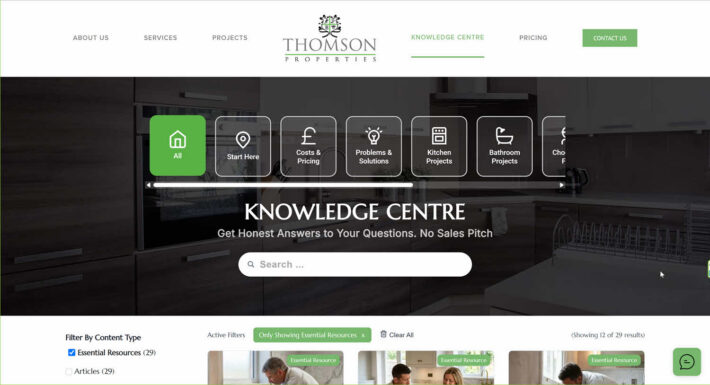
Not sure it fits your business? Fair. Go and read whether a done-for-you Knowledge Centre is right for you, and what it costs, with no pressure. You can also see my own Knowledge Centre and WindowTreat’s to judge the standard for yourself.
The project also pointed Steve and Chris toward future opportunities around smart automation, ongoing care and architect education. Plenty of room left to keep protecting the dream.
Next steps…
So here’s my challenge, and it points right back at you.
Pick the one question your buyers keep asking that you’ve been too polite, too cautious or too busy to answer in public. The price one. The “what goes wrong” one. The one your competitors are all hiding from.
Now ask yourself the only question that matters. Will answering it induce more trust?
You already know the answer. Not by accident. Not someday. By choosing to be the business brave enough to tell the truth first.
You have a gift, and you’re responsible for sharing it with the world. Make it happen.
If you’d like a proper conversation about whether this is the right fit for your business, no pitch and no PowerPoint, book a call with me here. And if it’s not right for you, I’ll tell you.
Project Specifics
-
Knowledge Centre
-
Writing Big 5 Topic Articles
-
Assignment Selling
-
AI Visibility
-
Lead Generation
-
Buyer Education
-
Radical Transparency
-
Founder-led
-
Search Visibility
-
Trust Building