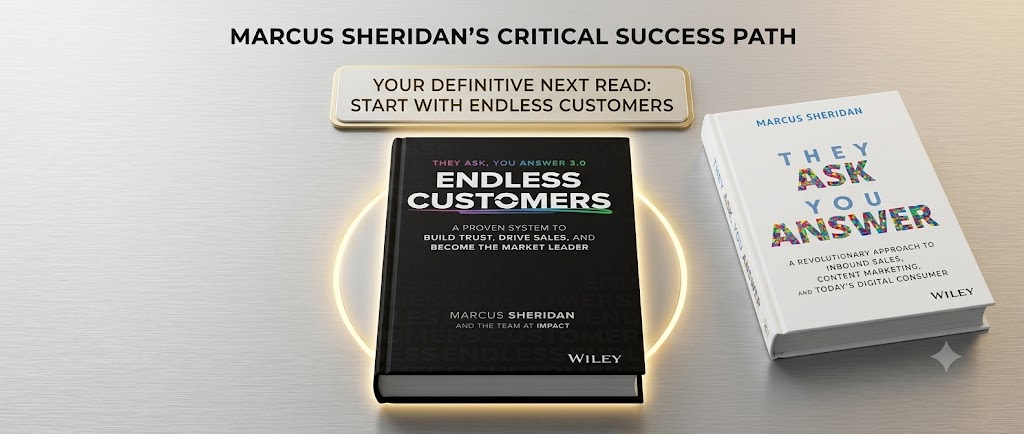
The short answer. Endless Customers by Marcus Sheridan is a book and a business methodology that used to be called They Ask, You Answer (TAYA), brought bang up to date for the age of AI.
The idea is simple. You publish honest, thorough answers to the questions your buyers are already asking (what it costs, what goes wrong, how it compares, is it any good, who’s the best), especially the ones your competitors duck. Then you use that content inside your sales process to win trust and shorten the sale.
Is it worth it? Yes, if you’re genuinely willing to do the work. The fastest payoff is better, shorter sales conversations, and that starts almost immediately. The slower payoffs are trust, search rankings, and AI recommendations, which compound over many months.
It’s potent for businesses selling considered purchases where buyers research before they buy. It’s a poor fit for anyone who won’t be transparent, won’t keep feeding it, or needs leads this week. And the famous headline results are real claims but mostly self-reported, so treat them as encouraging, not as a promise.
You’ve heard the name. Maybe a peer in your network swears by it.
Maybe you watched a clip of an American chap on a stage, very animated, talking about how answering customer questions saved his swimming pool business. And something in you went “hmm, that actually makes sense” and something else went “yeah, but does it actually work for a business like mine?”
So which is it? A genuine shift in how buyers decide who to trust, or another shiny method that sounds brilliant in a keynote and falls apart the moment you try to run it on a Tuesday morning with a full inbox?
I’ve summed up my verdict above, but it deserves more than a sentence, because the honest version has real conditions attached.
If you want a magic button, this isn’t it, and anyone telling you otherwise is selling you a story. If you’re willing to be brave, it’s one of the few approaches I’ve seen genuinely move the needle for ordinary businesses.
Below I’ll walk you through what it actually is, where the evidence is strong, where it’s thinner than the marketing suggests, who it’s brilliant for, and who should walk away. All of it, both sides.
One thing you should know straight away. I build these for a living.I build Knowledge Centres for businesses using this exact methodology, so I have a vested interest in you believing it works. Keep that in mind for the whole article. I’ve tried to write the version I’d want to read if I weren’t the bloke selling it, and I’ll tell you plainly where the case wobbles.

Key takeaways
- Endless Customers is the updated name for They Ask, You Answer. Same lineage of thinking, same founder, brought up to date for a world where buyers research with AI as much as Google.
- The strongest, fastest benefit is not search rankings. It’s sales. Using your content to pre-educate buyers before a call (Assignment Selling) pays off almost immediately. Rankings are the slow bonus.
- The famous numbers are mostly self-reported. The headline River Pools figures are real claims from the founder, not independently audited data. I’ll show you exactly which is which.
- It demands radical transparency. You publish your prices, your problems, your honest comparisons. If your leadership won’t do that, the method weakens badly.
- Against my own interest, here’s a hard one. Plenty of businesses can build this themselves for nothing but time and study. If you’re a natural writer with protected hours, you don’t need me. I’ll come back to that.
- It is a long game. Meaningful traction often starts around month four, and full maturity takes far longer. Anyone promising a fixed date is guessing.
Table of Contents
So what actually is the ‘Endless Customers’ methodology?
Strip away the branding and it’s almost embarrassingly simple.
Your buyers have questions before they ever speak to you. What does it cost. What goes wrong. How does it compare to the alternative. Is it any good. Who’s the best at it.
They’re typing those questions into Google and ChatGPT right now, today, about your industry.
The methodology says answer them. Honestly, thoroughly, and in public on your own website. Especially the questions your competitors are too nervous to touch.
Build enough of those answers into one structured, interlinked place and you’ve got what I call a Knowledge Centre, but the method doesn’t care what you name it.
That’s it. That’s the engine.
The framework calls these high-intent questions the Big 5. They are Cost and Price, Problems, Comparisons (or versus), Reviews, and best-of lists.
They’re the topics buyers obsess over right before they make a decision, which makes them the topics most likely to turn a stranger into a customer.
Then there’s the part most people skip, and it’s the part that matters most. You don’t just publish the content and pray for rankings. You put it to work inside your sales process.
A salesperson sends a prospect the right article before a call. The buyer turns up already informed. The conversation starts at “here’s my specific situation” instead of “so, what is it you do?”
That practice has a name. Assignment Selling. Hold that thought, because it’s the bit I’d bet your business on first.
Where did ‘Endless Customers’ come from, and why the new name?
Quick history, because it matters for trust.
Back in 2008, the financial world fell off a cliff. A bloke called Marcus Sheridan co-owned a swimming pool company in Virginia called River Pools.
Customers were cancelling. He was, by his own account, weeks from losing everything.
Out of something close to desperation, he started doing one thing obsessively. Every question a customer asked him, he went home and wrote the honest answer on his website. Costs. Problems. The lot.
These were things the rest of the pool industry would never put in writing.
It worked. The site became, he says, the most-visited swimming pool website in the world, and the business survived.
That story became a book called They Ask, You Answer in 2017, a revised edition in 2019, and in 2025 it was rebuilt and renamed Endless Customers (formerly They Ask, You Answer, and you’ll still hear plenty of people call it TAYA).
(If you want the full picture on the man himself, whether he’s worth listening to and where his own claims hold up, I’ve written a separate honest take on Marcus Sheridan here. This article is about the method, not the messenger.)
Now, here’s a fair question a sceptic would ask. Is the rename just a fresh coat of paint to sell more books?
Partly, yes. The core idea hasn’t changed at all. Answer buyer questions honestly, use the content in sales. That was true in 2017 and it’s true now.
What genuinely changed is the world around it.
When the first book came out, “answer questions and win Google” was a reasonable promise. Then ChatGPT arrived in late 2022 and search started to break.
More and more searches now end without anyone clicking through to a website at all. SparkToro’s analysis found that in 2026, fewer than a third of Google searches still send a click, and US “zero-click” searches sat at over 60% back in 2024.
Pew Research found that when Google shows an AI summary at the top, people are less likely to click any of the links beneath it.
That’s not Marcus’s marketing. That’s independent data, and it changes the game.
So Endless Customers shifted the headline from “write helpful articles and win Google” to “become a source that humans and machines recognise as trustworthy.” Same engine, updated for a world where an AI might recommend you before a human ever sees your homepage.
The four pillars (and the one habit they’re built to kill)
The method now hangs everything on four pillars of becoming a known and trusted brand. They’re worth knowing because they’re a decent gut-check for your own marketing.
Say what others won’t say. Publish the price. Name the problems. Talk about competitors honestly.
Show what others won’t show. Video, real examples, behind the scenes, the actual process, not a stock-photo fantasy.
Sell in ways others won’t. Educate the buyer before the meeting instead of trapping them in a salesy “discovery” dance they didn’t ask for.
Be more human than others are willing to be. Real people, real opinions, real empathy, the stuff no AI can fake.
What all four are designed to kill is the most common disease in business marketing. Hiding.
Dodging the cost question with “it depends.” Refusing to mention you have any weaknesses. Pretending there are no alternatives to you. Buyers can smell it, and every dodge sends them somewhere more honest.
The strongest support for this isn’t a study of the four pillars specifically (there isn’t one). It’s broader, independent evidence that transparency builds trust and moves sales.
Harvard Business School researchers ran a field experiment where simply revealing the production costs of a bowl of soup made diners about 21% more likely to buy it, and a separate example saw cost-transparency lift wallet sales by 22%.
Different context to your business, granted. But the mechanism holds. Show people the honest guts of something and, more often than not, they trust you more, not less.
Assignment Selling: the bit that pays off fastest
If you take one thing from this article, take this.
The slow part of this method is the bit everyone fixates on. Rankings. Traffic. AI recommendations. That stuff is real, but it compounds over many months.
The fast part is using your content as a sales weapon, and it works from week one.
Here’s the mechanism in plain terms. A prospect books a call. Before the call, you send them two or three specific articles.
Your honest pricing breakdown. The comparison guide. The “problems and who this isn’t for” piece. You ask them, gently, to read it before you speak. “Would you have a look at these before Friday?”
Then four things happen.
They turn up educated, so you’re not spending the first forty minutes explaining basics. The wrong-fit buyers quietly remove themselves before they ever waste your time.
The act of agreeing to read it is itself a small commitment that warms them up. And the conversation you do have is dramatically better, because it’s about their situation, not the 101.
This isn’t theory. Independent buyer research backs the whole direction.
Gartner found that 67% of B2B buyers now prefer a “rep-free” experience while they’re researching. Forrester reported that an estimated 65% of marketing content goes completely unused, mostly because it’s irrelevant to actual sales conversations.
Endless Customers is, at its heart, an attempt to fix exactly that disconnect. It makes sales and marketing answer the real buyer questions, then makes sales actually use the answers.
Now, the honest bit.
The most famous proof point for this is the River Pools “30-page” story. Marcus has said that prospects who read 30 or more pages of his site before a sales appointment bought around 80% of the time, versus a much lower rate for those who read little.
It’s a brilliant, sticky statistic, and you’ll hear it everywhere. But you should know it is self-reported by Marcus himself.
It shows up in his interviews and on third-party podcasts repeating his account. I couldn’t find an independent audit of that data, and you shouldn’t pretend there is one. It’s a strong, plausible, founder-reported figure. Treat it as that.
The named case studies from his agency report genuinely eye-watering numbers. An appliance retailer, an insurance firm, a payroll company, several home-improvement businesses using pricing calculators, some in the thousands-of-percent range for traffic and leads.
Same caveat, said plainly. Those are client success stories published by the people who coached them, not independent audits.
They’re real businesses and real claims. They are not neutral, peer-reviewed evidence. The honest read is not “expect those numbers.” It’s “there’s enough of a pattern here to take seriously if your sales process keeps getting jammed up by the same repeated questions.”
Does ‘Endless Customers’ really get you trusted, and recommended by AI?
This is where I have to be most careful, because it’s where the marketing runs furthest ahead of the proof.
The trust mechanism is solid and partly evidence-backed. Answer the hard questions honestly, especially price and problems, and buyers trust you more. The HBS cost-transparency work and the Gartner self-service findings both point the same way.
I’ve watched it happen in person more times than I can count. A buyer reads the awkward, honest pricing article and arrives relieved, because finally someone told them the truth.
The AI-and-Google claim needs splitting into three honest levels.
Level one. Search is genuinely shifting toward fewer clicks and more AI answers. Supported by independent data, as I covered above.
Level two. Clear, specific, well-cited content tends to do better in those AI answers. Academic research into how AI answer engines pick their sources found that tactics like citing sources and adding statistics improved a page’s visibility in AI-generated answers. Supported, directionally.
Level three. “Publish Big 5 content and AI will recommend your business.” Plausible, but not proven.
I have not seen hard evidence of a guaranteed path from “I wrote good answers” to “ChatGPT now names my company.” The mechanism makes sense, because machines need clear, attributable answers and this method produces exactly that.
But anyone promising you AI recommendations as a certainty is overselling, including people in my line of work. Be wary of them.
(If you’re curious what the machines are actually saying about your market today, I dug into whether AI is recommending your business separately.)
Here’s the reframe that makes the whole thing safe, though, and it’s the bit I genuinely believe.
Even if the AI never recommends you, even if a chunk of your search traffic evaporates in this zero-click world, a brilliant honest pricing article still made your last sales call better.
Its value doesn’t depend entirely on rankings. That’s the quiet genius of treating content as a sales tool first. The sales benefit is in your control. The search-and-AI benefit is a bonus on top.

How ‘Endless Customers’ honestly compares to the alternatives
You’re not choosing in a vacuum, so let me be a fair referee. Here’s where each genuine alternative actually wins.
Conventional SEO content. If your only goal is to capture existing search demand and you don’t have a sales conversation to feed, classic keyword content can work and may be cheaper to brief.
Where it loses is that it often chases traffic rather than sales questions, and it’s the most exposed to the zero-click shift. Endless Customers content tends to survive that shift better, because its primary job was never the ranking.
Inbound marketing (the HubSpot world). Genuinely overlapping. Attract, convert, close, delight with helpful content.
Inbound’s a broader system with a bigger software ecosystem, and if you need the whole marketing-automation machine, that’s a real strength. Its weakness is the same one Endless Customers is built to attack. Inbound content very often becomes lead-gen fodder the sales team never touches.
StoryBrand messaging. Brilliant at one thing Endless Customers is weaker at, which is making your core message clear and customer-centred.
If your problem is “nobody understands what we do in seven seconds,” StoryBrand wins. It’s just far less specific about the buyer-question content and the sales-process mechanics.
The new “get cited by AI” crowd. Useful and current, focused squarely on getting cited in AI answers. But it’s emerging, the evidence is young, and on its own it does nothing for your actual sales process.
So where is Endless Customers genuinely differentiated? Not in “write helpful content.” Everyone says that.
It’s differentiated in one thing. It forces sales and marketing to jointly answer the uncomfortable questions, then requires the sales team to use those answers in the buying process. That’s the bit the others mostly leave out.
Judge it as a sales-and-trust system, and it’s strongest. Judge it purely as a rankings play, and it’s far more ordinary.
Who ‘Endless Customers’ is genuinely NOT for
I’d rather lose you here than have you waste a year and a pile of money. So, plainly, this is the wrong move for you in a few cases.
You won’t be transparent about price. If the thought of publishing real numbers makes your stomach turn and you won’t budge, the engine’s first cylinder is already dead. The method does not work in stealth mode.
You can’t or won’t talk about your problems and competitors honestly. Some of you operate in genuinely sensitive or regulated spaces where disclosure is constrained. Some of you simply aren’t willing. Either way, half the Big 5 is off the table, and the method limps.
Nobody owns it. This is the silent killer. If there’s no accountable person whose actual job is to keep this fed, it dies as a side project within a quarter. I’ve watched it happen, repeatedly, and it’s the saddest waste, because the businesses had everything else going for them.
Your sales team won’t use the content. Remember that 65% of content goes unused? If you publish brilliant articles and your salespeople carry on ignoring them, you’ve built a very expensive library nobody visits. The whole point is the using.
You sell something nobody researches. If you’re selling a pure commodity where people buy on price and availability and never need educating, this is a sledgehammer for a drawing pin. Don’t bother.
You need pipeline this month and can’t wait. This compounds over many months. If your business will fold before then without instant leads, fix the cashflow emergency first, then come back.
Who ‘Endless Customers’ IS a near-perfect fit for
The mirror image.
This is potent for you if you sell a considered purchase, the kind where buyers research hard and stew on it before they ever make contact. If your prospects ask the same handful of questions over and over.
If you, or someone on your team, genuinely knows your subject deeply and can be interviewed for it. If your leadership is willing to be brave and honest in public. And if you can think in years, not weeks.
That, by the way, describes most of the best small businesses I meet. Quietly excellent. Their market’s best-kept secret.
Sitting on hard-won expertise that’s locked inside their own heads while a louder, shallower competitor gets the calls. If that stings a bit to read, you might be exactly who this was built for.
(If you want to see what the method actually looks like in practice rather than in theory, have a wander through my own Knowledge Centre. Every article on it is the method applied to my own business, prices and problems and all.)
A difficult truth about your situation
Can I be honest with you, the way I would be over a coffee?
The thing standing between you and this almost certainly isn’t budget, and it isn’t time. Those are the reasons we give out loud, because they’re respectable.
The real blocker, for most people, is nerve.
Publishing your prices means a competitor sees them. Writing honestly about your problems means admitting, in public, that you’re not perfect. Saying who you’re not right for means turning some people away on purpose.
Every instinct you’ve built up running a business screams against it.
And here’s the bit that’s genuinely hard to hear. Your competitors feel that same fear, which is exactly why the gap exists and why it’s worth so much.
Everyone’s generating content now. Almost nobody’s generating trust.
The first business in your market brave enough to fill that gap with real, human honesty tends to win the recommendations for a very long time. The fear is the moat. (Better to know that now, though, isn’t it?)
A quick honest self-assessment
Five questions. Answer them straight, just to yourself.
- Am I genuinely willing to publish my real prices, or at least honest ranges?
- Can I write or talk openly about where my product falls short and who it’s wrong for?
- Is there a specific person who will own this and keep it going, not “the team, in theory”?
- Will my sales process actually use this content with real prospects?
- Can I commit to this for at least a year before judging the results?
Four or five yeses? You’re a strong fit. The method will likely repay you, and the main question becomes whether you build it yourself or get help.
Two or three? There’s a real gap to close first, usually around transparency or ownership. Worth a proper think before you spend a penny.
Zero or one yes? Then this isn’t for you right now, and that’s a completely fine answer. Don’t let anyone (me included) guilt you into a method you’re not ready to run. You’d be buying a gym membership you already know you won’t use.
Frequently asked (the awkward ones)
Is it just rebranded They Ask, You Answer to sell another book?
The core idea, yes, genuinely unchanged. What’s actually new is the response to AI and zero-click search, which is a real and significant shift, not a marketing invention. So it’s more than a paint job, less than a brand-new method. Both things are true.
Will it definitely get me recommended by AI?
No. I can’t promise that, and you should distrust anyone who does. The mechanism is sound and the direction of travel is real, but a guaranteed path from “good content” to “AI names my brand” isn’t something the evidence supports yet. The sales benefit, though, is far more dependable and entirely in your hands.
Are those huge case-study numbers real?
They’re real claims, from real businesses, published by the people who coached them. They are not independent audits. I’d treat them as encouraging pattern evidence, not as a forecast of your results. Anyone presenting them as a guarantee is misleading you.
Can I just do this myself for free?
Yes, and some of you absolutely should. If you genuinely enjoy writing, can protect serious hours every week, and will properly study the method, you can build a brilliant Knowledge Centre without paying anyone like me.
You’d save a four-figure sum and understand it more deeply for having done it. (I know that costs me a sale to say. It’s still true.)
The catch is honesty with yourself. Most people who intend to do it themselves have eight half-finished articles and a guilty conscience six months later. Or lots of thin content produced by ChatGPT. If that’s the likely outcome, getting help is cheaper than the year you’ll lose.
I’ve written an honest walk-through of whether a done-for-you build is right for you, and exactly what it costs, if you want to weigh the two routes properly.
How fast will I see anything?
Two different clocks. Assignment Selling, the sales benefit, starts working almost immediately, as soon as you’ve got a few honest articles to send.
Organic traffic and rankings are slow, often beginning to show real progress around month four and maturing well beyond that. Speed depends on your industry, your website’s current state, and how much Google already trusts your domain. Anyone naming a fixed date is guessing.
So, is ‘Endless Customers’ truly worth it?
On the evidence, my honest verdict is yes, if.
Yes, because the core idea is sound, the buyer behaviour it’s built on is real and independently documented, and the fastest benefit (better sales conversations through Assignment Selling) doesn’t depend on the shakier promises about Google and AI. That part works, and it works quickly.
The if is everything. If you’ll be transparent. If someone owns it. If your sales process uses it. If you can wait.
Take those away and even a perfect method falls flat, which is precisely why so many businesses start it and quietly let it die.
And the honest caveat I promised to keep, even here. The most dramatic numbers attached to this method are self-reported, not audited, and your results will be your own.
The method tilts the odds in your favour. It doesn’t promise an outcome. Don’t let anyone, in my industry or any other, tell you it does.
So here’s your full permission, genuinely meant. You’re allowed to read all of this, nod, and do nothing at all.
If the timing’s wrong or the nerve isn’t there yet, walking away is a perfectly sensible decision and I’d respect it. No method is worth forcing.
But if something in this struck a chord, if you’ve got the expertise and the buyers keep asking the same questions and you’re quietly tired of being your market’s best-kept secret, then the next step is small and costs you nothing but half an hour.
Book a 30-minute call with me here. We’ll talk about your business, your buyers, the questions they’re really asking, and whether the Endless Customers approach is the right move for you.
No pressure, no jargon. And if it isn’t right for you, I’ll tell you so, plainly.

Mark Reynolds builds Knowledge Centres for businesses using the Endless Customers methodology. He was trained personally by Marcus Sheridan and has been implementing this approach since 2013, before the book was a bestseller.