How a Specialist Podiatry Clinic Put Its Expertise Where Buyers Actually Look, Without Churning Out Content Nobody Asked For
We Fix Feet had decades of clinical know-how sitting inside two clinicians' heads. Here is how we turned it into a Knowledge Centre that answers the real questions patients ask before they ever pick up the phone. It's built on the Endless Customers methodology by Marcus Sheridan (formerly "They Ask, You Answer").
Client:
We Fix Feet
Project
Knowledge Centre + 30x Big 5 Articles + 8x Core Topic Ultimate Guides + AI Digital Twin + 60 photos + 30 Article Summary Videos
Written by Mark Reynolds, The Knowledge Centre Guy
At a Glance
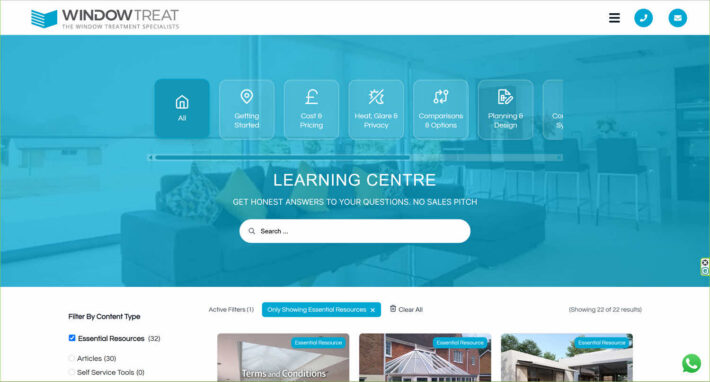
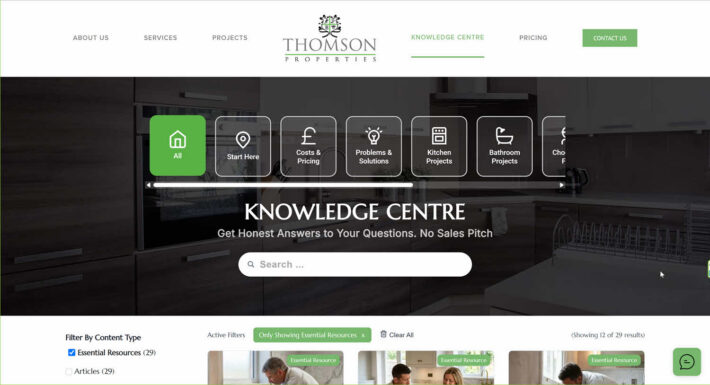
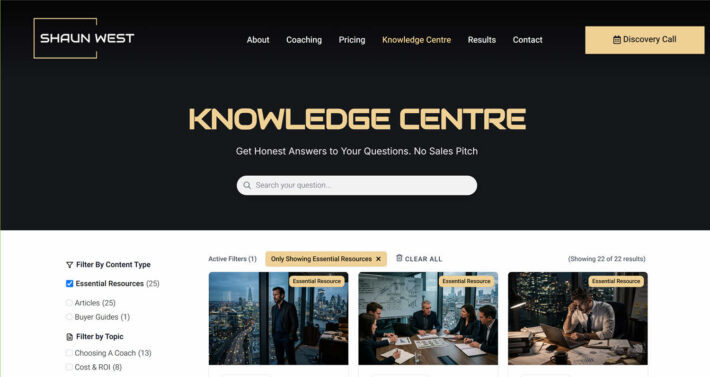
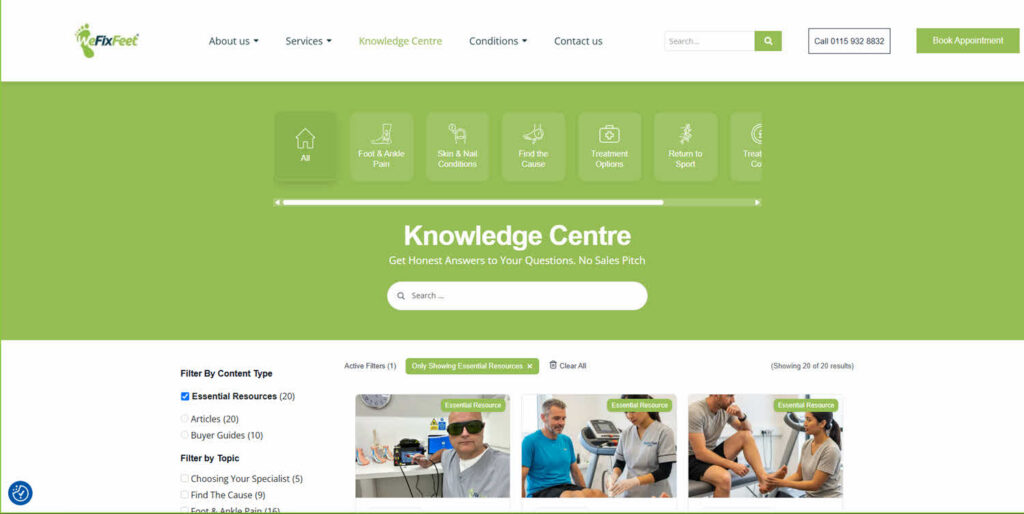
When you visit the WeFixFeet Knowledge Centre you may see some articles written by Steve and Darren and some written by me – The Knowledge Centre Guy. To save you time digging around, here are links below to some of the almost 40 articles I wrote.
When we published their Knowledge Centre I had written 7 core topic articles which are located along the top of the Knowledge Centre PLUS approximately 20 Big 5 topic articles PLUS a critical in-depth author article which is so important for credibility, and Google/AI powered search loves them.
Big 5 Topic Articles:
Author article:
Core Topic Articles:
- Foot & Ankle Pain – Core Topic page that links to related articles.
- Costs & Pricing – one of the most popular Core Topic pages – (You can see the other core topic pages across the top of the Knowledge Centre in that scrollable area).
| Company | We Fix Feet |
| Who led it | Steve Carter and Darren Bloore (owners), with Mark Reynolds, The Knowledge Centre Guy |
| Industry | Specialist podiatry and sports injury care |
| Team | Founder-led. Two owners and a small clinical team across two clinics in Ilkeston, Derbyshire and Beeston, Nottinghamshire |
| Problem | Deep clinical expertise that buyers couldn’t find. The real questions about cost, treatment and “can you actually fix this?” were being answered in the treatment room, not online |
| What they did | Built a done-for-you Knowledge Centre around roughly 20 priority buyer questions using the Big 5 framework, weighted heavily towards cost and problems content |
| Timeline | Knowledge Centre launched January 2026. Phase one built around the highest-priority buyer questions |
| Result | A live Knowledge Centre that educates better-fit patients before they book. Early stage. The asset is live and being built out |
| Source | A Knowledge Centre Guy client project. Written by Mark Reynolds |
| Defining line | “We Fix Feet had the clinical expertise. The challenge was turning that expertise into the questions patients were actually asking before they booked.” |
Two Clinicians Who Were the Product
Ever met a business owner who is the thing they sell?
That’s Steve and Darren. Between them they run We Fix Feet, a specialist podiatry and sports injury clinic with sites in Ilkeston and Beeston. Heel pain, Achilles trouble, plantar fasciitis, biomechanical assessments, shockwave, laser, orthotics, the lot.
Their whole approach is goal-based. They ask what you want to get back to doing, running a 10k, chasing the grandkids, standing a shift without wincing, then they build the plan around that.
And here’s the bind every owner like Steve and Darren knows in their bones.
The knowledge that makes you brilliant is the same knowledge you never have time to write down. You’re in the room all day. You’re a clinician, a business owner, a manager and a marketer, often before lunch.
They weren’t after “some blog posts.” They were building a proper buyer-education asset. They were also pushing the business towards higher-value MSK and sports injury work, with packaged, goal-focused care rather than open-ended pay-as-you-go appointments. The strategy was sound. The expertise was real.
It was just trapped.
The Problem: The Best Answers Were Disappearing After Every Appointment
So where does a person in pain actually go first?
Not to your clinic. To Google. Then increasingly to ChatGPT. They type “why does my heel hurt in the morning,” “is shockwave therapy worth it,” “how much does treatment for plantar fasciitis cost.” They’re scared, they’re sceptical, and they’ve usually already tried something that didn’t work.
That last point matters more than any other. The single biggest question landing on We Fix Feet was some version of: “Can you actually fix this, especially if I’ve already tried physio, NHS advice, or sorting it myself?”
Steve and Darren answered that question beautifully. Every single week. In the room. To one person at a time. And then the answer vanished the moment the patient walked out.
Meanwhile their website did what most websites do. It listed what they offered. It didn’t help anyone decide. That’s the gap. A service page says “we do shockwave therapy.” A buyer in pain wants to know “will shockwave fix my heel, how long will it take, what will it cost, and why is it pricier than the bloke down the road?”
There’s a real cost to staying quiet about all that.
Not the cost of the website. Not the cost of the ads. The cost of the silence itself.
Because a buyer who can’t get a straight answer from you will get one from somewhere. A competitor. A forum. A chemist’s shelf and a tube of something “98% effective for superficial infections.” And once they’ve trusted that other voice, you’re already behind.
This is also where most businesses confuse two very different things. A blog is company news.
Nobody searches for your company news. A Knowledge Centre is something else entirely. It answers buyer questions, fears, costs and comparisons, in the buyer’s own words. If you want the full distinction, I’ve written it up here: What’s a Knowledge Centre, and is it worth it?
And the stakes have shifted again.
It isn’t only Google reading your content now. It’s the AI tools your buyers are asking for recommendations. If your expertise isn’t written down, plainly and honestly, it can’t be found, ranked or recommended. It simply doesn’t exist as far as the machines are concerned. (Worth a hard look: who is AI recommending in your market?)
Done Properly, Not Done Eventually
I know how frustrating it is when you’ve built something genuinely good and the people who need you can’t find you.
I’m Mark Reynolds, The Knowledge Centre Guy. I’ve been doing this work for a UK audience for a long time. I’ve been implementing They Ask, You Answer since 2013, before the first book was even published, and I’ve spent 25 years in web, search and conversion before that. I’m one of only a handful of Certified Endless Customers Partners in the UK, trained personally by Marcus Sheridan and his team over a twelve-month programme. Not someone who read the book on a train. (More on my background here.)
Now, here’s the bit I really want you to notice, because it’s the bit that decides everything.
Almost every owner who comes to me has already tried to do this themselves. And 100% of the time, when they show me the articles they wrote following the framework, they’re not good enough yet. That isn’t a knock on them. It’s the Law of the Coin. The same thing that makes you brilliant in your field, total absorption in the work, is the thing that leaves you no road and no runway to get this done to a world-class standard.
DIY rarely fails on ability. It fails on determination, time and the hundred other fires burning in a small business. Handing it over isn’t admitting defeat. It’s how it actually gets finished. To a high standard. At speed. (This is the done-for-you service.)
The Plan: Three Simple Steps to Pull the Expertise Out of Their Heads
Big projects feel risky. So let me show you how simple the path actually was.
Step one. Extract the expertise. I sat with the real thinking behind We Fix Feet. The goal-based approach. Why a package can be better value than a string of one-off appointments. Why a proper biomechanical assessment is a world away from being filmed on a treadmill in a trainer shop. The honest stuff. The stuff Steve and Darren actually believe.
Step two. Choose the right questions, not the most questions. This is where a lot of content goes wrong. It chases volume. We did the opposite. Steve and I talked through which questions genuinely deserved phase-one priority and which could wait. We landed on roughly 20, weighted towards cost and problems, because those two have the strongest pull on a buying decision. The Big 5 gave us the spine: cost, problems, comparisons, reviews, and best in class.
Step three. Write it the way a patient actually talks. Steve was firm on this, and he was right. Not clinical. Not academic. The words a worried person types at 11pm, not the words on a referral letter. Mostly straight, unbiased education, with only a smaller part explaining where We Fix Feet fits. Because education that’s honest first earns the right to sell second.
Three steps. That’s the whole plan. The expertise was always there. We just gave it somewhere to live.
The Decision: “But We’re Healthcare, We’re a Bit Different”
It’s a fair worry, and it comes up in nearly every regulated field. “We’re clinical. We’ve got HCPC, insurance, things we have to be careful about. Surely this transparency stuff is for double-glazing firms, not us?”
(It nearly always comes up. And the answer’s nearly always the same.)
Here’s the single question that cuts through it. Will this induce more trust? If yes, you do it. Every business, clinic, accountant, insurer, freight firm, is in the business of trust before it’s in the business of anything else. Being careful about clinical claims and being honest about cost, options and outcomes are not in conflict. They’re the same instinct.
The opposite, staying vague and hoping, is the ostrich move. Heads down, hoping the question goes away. Tech changes. Trust doesn’t. And every time you duck a hard question, you hand the buyer to whoever’s brave enough to answer it.
Steve and Darren didn’t duck it. They put their thinking on the table.
Success: What’s Built, and Where It’s Going
Now, be honest with yourself about timelines for a second.
The We Fix Feet Knowledge Centre went live in January 2026. That’s recent. So I’m not going to wave a chart of traffic and leads at you. Pulling real numbers takes time, and I’d rather show you nothing than show you something I can’t stand behind. That’s the difference between a case study and a sales pitch.
Here’s what I can tell you, plainly.
The expertise is no longer trapped. The questions Steve and Darren answered one patient at a time are now written down, in plain language, working around the clock. Think of the Knowledge Centre as the most patient member of staff they’ll ever take on. One who answers the same heel-pain question at 11pm on a Sunday, never sighs, never books a holiday, and gets a little more trusted every month it’s left running.
And there’s an immediate, practical win that needs no analytics dashboard at all. Assignment Selling. When a patient asks a big question, the team can now send the article that answers it before the appointment. So the person arrives already understanding why structured, goal-based care works. The consultation gets better. The patient self-selects. Better-fit patients, less explaining, fewer time-wasters.
So where does this lead once the content compounds? You don’t have to take my word for it. Look across the Atlantic.
You’ll notice the proof below is from US companies. That’s simply because Marcus Sheridan is American and Endless Customers has built a huge following there. If anything, that’s good news for you. The US is a few years ahead of the UK on this, which means the opportunity here is wide open and the playbook is already proven. The emotion underneath all of it is trust, and trust unites businesses everywhere, Ilkeston or Illinois.
- InTek Freight. As Marcus Sheridan shares in Endless Customers, CEO Rick LaGore couldn’t afford a content team, so he wrote all 92 articles himself in year one. His leads went from 5 to 8 a month to 125 a month. Proof that the articles are the engine.
- RetroFoam. As Marcus shares in the book, RetroFoam had plateaued and was stuck competing with bigger brands. By committing to honest, educational content, they doubled the business. Proof that you can win against larger players with transparency, not budget.
That’s the destination We Fix Feet is now driving towards, with the asset already live and growing.
What This Means for You
So read this back through your own front window for a moment.
If you’re sitting on hard-won expertise that your buyers can’t find, you have exactly the problem Steve and Darren had. It doesn’t matter that you’re healthcare and they were roofing, or that you’re B2B and the example was B2C. The mechanics never change. People ask questions before they buy. Whoever answers them best earns the trust. Whoever answers them best gets recommended, by Google and by AI.
And if you don’t do it, other sharks in your market will scrape up the pieces. They’re already circling the questions you’re too busy, or too nervous, to answer.
Not sure it’s right for your business? Good, that’s the right question. I’ve written an honest piece on exactly that: Is a done-for-you Knowledge Centre right for us? And if cost is on your mind, I’ve put real numbers, not “it depends”, here: the cost of a Knowledge Centre.
Your Move
Let me leave you with the question I’d ask if we were sat across a table with a coffee.
Your buyers are typing their questions into a search bar tonight. The only thing in doubt is whose answers they find. Yours? Or someone else’s?
You have a gift, and you’re responsible for sharing it with the world. Make it happen.
Book a 30-minute chat with me here. No pitch. Just a straight conversation about whether your expertise deserves to be found. (Or see what a finished Knowledge Centre looks like first.)
Project Specifics
-
Knowledge Centre
-
Writing Big 5 Topic Articles
-
Assignment Selling
-
AI Visibility
-
Lead Generation
-
Buyer Education
-
Radical Transparency
-
Founder-led
-
Search Visibility
-
Trust Building