Your potential customers are asking ChatGPT who to hire, who to buy from, who to trust.
Whatever your industry – trades, professional services, B2B, retail…
…they’re typing things like “best [what you do] near me” …and AI is answering them.
And AI doesn’t just throw back a list of links like Google. It picks specific businesses by name, categorises them, tells your buyer who’s best for what – and says “start here.” It even recommends specific providers even when knowing nothing about the searcher – not too helpful.
If you’re not on that shortlist, those customers never even know you exist. This guide gives you four free tests to check where you stand, in about fifteen minutes, without paying anyone a penny.
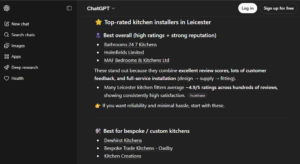
Not too long ago I ran this test for a kitchen installer in the Midlands. I asked ChatGPT: “Who’s the best kitchen installation company near Leicester?”
It came back with a detailed breakdown: top-rated companies, best for bespoke kitchens, best for value, even a “how to choose” section with criteria. It named over a dozen businesses, categorised and ranked.
His wasn’t mentioned anywhere.
Twenty-two years in the trade. Thousands of kitchens fitted. Five-star reviews everywhere. And the AI recommended a company that had been going three years because that company had 40 articles on their website answering every question a buyer could ask.
I ran the same test for a HR consultancy in Manchester. B2B, four-person team, 12 years of proper expertise.
ChatGPT recommended two larger firms because those firms had published detailed articles about tribunal processes, redundancy costs, settlement agreements.
The consultancy? Not a mention. Not because they weren’t good enough.
Because their website said nothing.
Well they did have some of those boring blog posts produced by a SEO agency using ChatGPT, this isn’t an time for AI slop.
You need to be doing more.
In many markets, when I run this test, the AI can’t confidently recommend anyone. It hedges. Gives generic answers. It can’t find a business that’s given it enough honest, detailed information to recommend with confidence. When it does give specific recommendations, the AI search has move to go on about that provider, there are more trust signals on their website and around the web.
That’s either very good news or very bad news for your business. It depends on four things.
And you can check all four yourself, right now, for free. No tools needed. No sign-ups. Just you, an incognito browser, and about fifteen minutes.
But before you start, one thing matters more than anything else: do not use your normal ChatGPT account.
This comes from Marcus Sheridan – author of Endless Customers (previously They Ask, You Answer), and the person who literally wrote the book on how businesses build trust online through radical transparency.
His methodology is behind some of the most visible businesses on Google and AI search in the world, and I’m one of only 5 people in the UK certified to implement it.
Marcus says that your regular ChatGPT account already knows who you are, what you do, and what you want to hear. It’ll tell you you’re brilliant. That’s not what your buyers see.
Your buyers are strangers. They don’t know you. And ChatGPT shouldn’t know you when you run these tests.
So then, to make sure you give yourself a chance of seeing what others see in ChatGPT, do this…
Open an incognito browser window and go to ChatGPT without logging into your account. That way you’re seeing exactly what a potential customer sees – no flattery, no memory, just an honest answer based on what’s out there.
Do this for every test below.
Test 1: Does AI actually recommend you?
This is the big one. In your incognito browser, ask ChatGPT: “Who is the best [your service] in [your area]?”
Marcus Sheridan put this to a room of 1,500 business owners at the UK’s Entrepreneurs Circle Convention [where he mentioned me from the stage!]. He asked them to raise their hand if they were sure AI was recommending them.

Almost nobody raised their hand. Then he also asked how many used ChatGPT without logging in (and in browser’s incognito mode) just for testing what real buyers see. Less than 5% of the room.
When you run this test, one of three things will happen.
- AI will recommend you (great – but keep reading, because the next tests will show you whether that’ll last).
- It’ll recommend your competitors (now you know who you’re up against).
- Or it’ll hedge and give a vague, non-committal answer because it can’t find a single business in your market worth recommending with confidence.
That third option is the most common. And it’s actually the biggest opportunity, because the first business to give AI a reason to recommend them will own that space.
Test 2: Could ChatGPT write your website without ever talking to you?
Still in your incognito browser without logging in (this is important – you need ChatGPT to have no idea who you are), ask it to write about what you do. Your services. Your industry.
Don’t give it your URL.
Just describe the topic and let it write.
- For example, if you’re a plumber, you might type: “Write me a page for a plumbing company’s website about their boiler installation service.”
- If you’re an accountant: “Write website content for an accountancy firm explaining their tax planning services for small businesses.”
Whatever your core service is – ask ChatGPT to write about it as if it were writing your website from scratch.
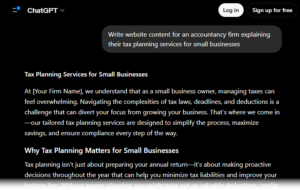
If what comes back looks suspiciously similar to what’s already on your site… you’ve got a problem. (And you’re not alone. I see this every single week.)
A roofing company in west Birmingham did this.
They asked ChatGPT to write about flat roof repairs. What came back was almost word-for-word what was already on their website. Generic stuff about “experienced professionals” and “quality materials.”
Nothing about the fact that 70% of the flat roof repairs they do are fixing botched jobs by other roofers, or that EPDM rubber roofing has made felt roofs almost obsolete, or what it actually costs to get it done properly versus getting a cheap fix that fails in three years.
An IT support firm in Bristol did the same thing.
Asked ChatGPT to write about managed IT services.
What came back could have been copied from any of the 200 other managed IT companies in the South West. Nothing about why they tell certain businesses not to move to the cloud yet. Nothing about the real cost difference between break-fix and managed support when you factor in downtime. Nothing about the conversation they have with every new client about cyber insurance before they touch a single server.
If ChatGPT can write your website without talking to you, your website says nothing worth recommending. The expertise is there. The opinions are there. The stories are there. They’re just not on the website yet.
Whether your buyers are homeowners looking for a plumber, business owners choosing an accountant, or procurement managers shortlisting suppliers. Same test, same result.
That’s not a ranking problem. That’s a “why would anyone choose you?” problem.
Test 3: Does your website honestly discuss what things cost?
Not “request a quote.”
Not “prices start from…” followed by nothing useful.
Actually, properly, discuss what things cost and what drives the price up or down.
Most businesses won’t do this. They’re terrified a competitor will undercut them or a customer will judge them before picking up the phone.
I get it. I really do.
But here’s what’s actually happening: your buyer is Googling “[your service] cost” right now.
And it doesn’t matter whether you’re a one-person operation quoting jobs from your van or a 20-person firm with a sales team and a CRM.
Your buyers are searching for the same thing – an honest answer about what this is going to cost them.
Marcus Sheridan’s company tracked one single article about fibreglass pool costs. It generated over $35 million in sales. Not because they gave exact prices, but because they educated buyers on what drives the cost up, what drives it down, why some companies charge more, and why some charge less. They were the only company in the world willing to answer the question honestly. Everyone else hid behind “request a quote.”

If your website doesn’t answer that question, someone else’s will. And that someone else just became the trusted expert. Not you.
Pricing transparency is the single biggest trust signal Google and AI look for when deciding who to recommend. It’s also the one almost every business refuses to provide.
(Which is exactly why it’s such a massive opportunity for the ones brave enough to do it.)
Test 4: When was the last time you published something a competitor would be uncomfortable reading?
Something that compared your service to alternatives, fairly. Whether that’s you versus a national chain, you versus doing it in-house, or you versus a cheaper option that cuts corners. Something that admitted a real limitation. Something that said “if you need X, we’re probably not the right fit.”
Marcus teaches his clients to publish “best of” articles listing the top companies in their area, including their competitors, with honest criteria.
One pool company in the USA did this and within 48 to 72 hours they were showing up as AI’s second recommendation for their entire state. Just from one piece of content.
If the answer is never, you’re playing it safe. And safe is invisible.
Google and AI don’t recommend the business that says the least. They recommend the one that answers the most – honestly, thoroughly, without hiding behind marketing fluff.
What your four tests probably just revealed
If you actually ran through those tests (and I hope you did), you’re likely sitting with one of two reactions right now.
Either you’re thinking “That’s worse than I expected” – which is uncomfortable, but now you know. Or you’re thinking “So my website needs work. I already knew that.”
But here’s the bit most people miss.
Almost every other business in your market has the same problem.
Right now, in most industries, there is a wide open gap. Google and AI are actively looking for a business to recommend with confidence and finding almost nobody who’s given them enough real expertise to do it.
The first business in any market that fills that gap properly owns the recommendations. Not for a quarter. For years.
It doesn’t matter whether you’re a sole trader, a husband-and-wife team, or a business with 15 staff and a sales pipeline. The businesses getting recommended all have one thing in common: they’ve put their genuine expertise on their website. Not agency-written fluff. Not AI-generated filler. Their actual knowledge – the stuff they’d tell you over a coffee if you asked how it really works.
That’s what a Knowledge Centre is. It’s your expertise. Your real answers to real buyer questions about cost, comparisons, problems, and process – structured on your website so that Google and AI can find it, trust it, and recommend you because of it.
I’ve built Knowledge Centres for a 10-person chassis fabricator, a nursery owner, a window treatment specialist, and professional services firms. The pattern is always the same: the expertise is already there. It’s in their head. It just isn’t on their website yet.
I built one for Bristol Bifold back in 2013. One article – an honest guide about how to choose the best bifold doors – ranked #1 nationally for years and helped generate over £500,000 in additional annual sales. When the company was acquired, the new owners hired me immediately to keep it going. That’s how valuable the asset was.
That’s the opportunity. And right now, in your market, it’s probably wide open.
Where to go from here
The four tests above give you a genuine feel for where you stand.
They’ll tell you whether your website is giving AI something to work with, or whether you’re invisible.
For a lot of businesses, that’s enough to get started. You now know the questions to ask. You know what “good” looks like.
You can start writing content built from your real expertise – the stuff that makes you different – and begin closing the gap yourself.
But there are things the DIY tests can’t tell you.
They can’t show you how you compare to your competitors across all four major AI platforms – not just ChatGPT, but Claude, Perplexity, and Gemini too.
They can’t check whether your website has technical issues stopping AI from reading it properly.
And they can’t tell you exactly how much business you’re losing to the businesses that have already started on this.
Are you actually invisible in AI search? Are you too scared to find out?
If you want the full picture, check out my AI Visibility Audit (I share samples reports too) covers everything the DIY tests don’t.
- I personally test your business across all four AI platforms using 10 real buyer prompts.
- I check 9 technical factors.
- I show you exactly who’s getting recommended instead of you, and I give you a prioritised plan for fixing it – ranked by the impact each fix will make.
You’ll have it in your hands within 5 working days.
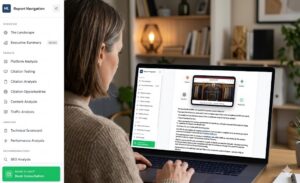
It’s £195. No subscription. No ongoing commitment. Just one report, complete clarity on where you stand and what to do about it. Check out my AI Visibility Audit here.
(The normal price is £495. I’m running an introductory rate while I build up case studies for this service – yes that is truly the reason. That honestly won’t last forever.)
Whether you run the DIY tests and crack on yourself, or decide you want the full audit – the important thing is that you check. Because your competitors will. And the businesses that get this sorted first are the ones AI learns to trust and keeps recommending.
Are you going to wait until they catch up? Take a look at what the audit is all about – and also FAQs to help you.