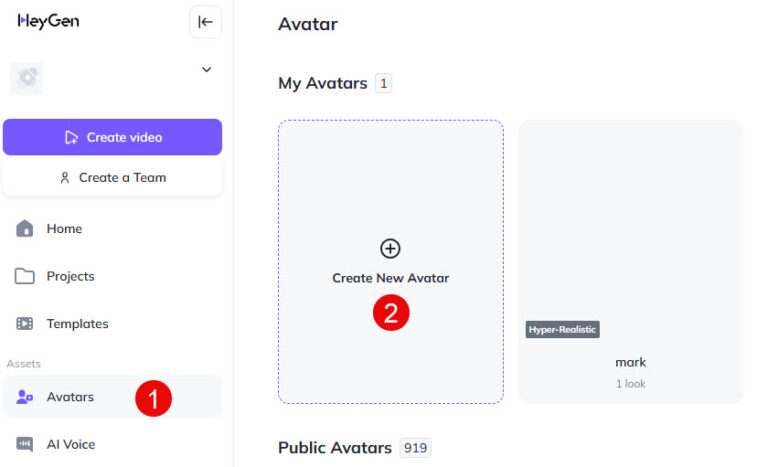
An AI avatar, also called a digital twin, is a realistic video version of you. You type a script, and out comes a video of you saying those words, in a professional clone of your own voice.
You don’t film it. You don’t edit it. It looks and sounds like you, because it was built from you.
That’s the whole idea. A video of you, without you having to make a video.
Now here’s why it matters.
Up to 20 minutes. That’s how long it will take you to go from a blank page to a finished two minute video of you, live on your website.
Compare that with how video normally goes in your business. Half a day, if everything runs perfectly. Three weeks, if the footage sits on a hard drive waiting for somebody to edit it. Or, far more likely, never.
The effort that stopped you is gone.
Picture it. Half seven in the evening, you’re on the sofa, and you have a genuinely good idea for a video. Something a buyer asked you that day that you answered brilliantly.
Right now, what happens to that idea?
Nothing. Because acting on it means the camera, the lights, the tidy room, getting changed, putting your best frock on, and forty minutes of takes. So the idea goes in the bin, along with all the others.
With an AI digital avatar, you type it up and hit generate. Video done, on your website, before you’ve finished your cup of tea (well not quite, but it’s quick!).
That’s the bottleneck. And it’s the one holding your sales and marketing back.
So what do you actually get from me?
Two things, and they’re worth separating.
One. Your own digital twin, built once and yours to keep. An asset that sits in your business long after my work is finished. Use it for social posts, ad creative, training videos, personal video emails to prospects, even other languages. Most of your competitors have no face on their website at all, so this is one of the cheapest ways left to look like a real business run by a real person.
Two. A summary video at the top of every article I write for you. Two to three minutes of you answering that article’s question in your own voice, for the buyer who doesn’t want to read fifteen hundred words. Same expertise, delivered the way they’d rather have it.
And because each video is short, there’s nothing to edit. Which is the only reason it becomes something you can keep doing, rather than one video you made in 2024 and never followed up.
One thing to say early, because it saves us both time. I don’t sell avatars on their own. They come as part of a Knowledge Centre build, where I write the articles and your avatar presents them. And my bias? Obvious. This is how I make my living.
Want to see one straight away? Jamie Thomson’s is here, at the top of one of his articles. Or book a call with me and we’ll work out together whether this fits your business.
Five things worth knowing
- It’s a realistic video of you, built from a typed script. You record video once, then never again. Change a sentence and remake it in minutes.
- It isn’t a stand-alone service. It only comes with a Knowledge Centre build.
- Its main job is summarising your articles. Two to three minutes at the top of each one, for buyers who’d rather watch than read.
- Against my own interest. Real video that you film yourself is better whenever you’ll actually do it. And the avatar is close to the real you rather than identical to it.
- You keep it afterwards, it improves as the technology does, and it runs on a third-party platform at roughly £45 a month paid to them rather than to me.
Worth it or not depends almost entirely on one thing, and I’ll get to it.
Why does the video never actually get made?
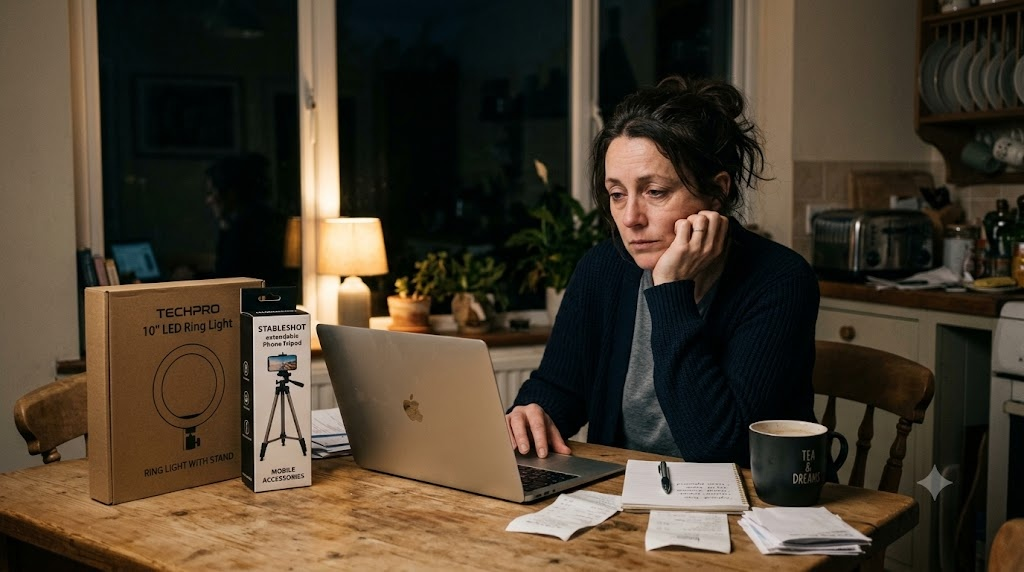
How many times have you told yourself you’ll finally get some video on your website? And how many have you recorded? (No judgement. I’ve watched dozens of sharp owners do exactly the same thing.)
It’s never because you doubt video works. You know it works. Marcus Sheridan made the point on stage at the Entrepreneur Circle convention in Birmingham, citing research that 77% of consumers prefer to buy from a company whose executives are active online.
So what stops it? Not one big obstacle. Eight small ones, stacked on top of each other.
- Time. A finished two-minute video eats half a day once you count setting up, filming, watching it back and hating it.
- Confidence. Plenty of owners simply don’t like being filmed. It isn’t a character flaw. It’s a skill they never needed until now. And in my experience it stops more video getting made than the other eight put together.
- Retakes. Nobody is good on camera first take. You fluff a line at ninety seconds and start again. Then again.
- Kit and sound. Bad audio is what makes amateur video look amateur, and most owners find that out after they’ve filmed everything.
- Editing. The bit that kills it. Footage sits on a hard drive for four months because editing is somebody’s fifth priority.
- Other people’s diaries. A videographer needs a slot, a tidy room, and a day where nothing goes wrong. Rare in a small business.
- Consistency. Video forty looks nothing like video one, because you filmed them nine months apart in a different room wearing a different shirt.
- Anything changing. You put your prices up and the video is now wrong. Which means filming it again.
- Volume. The one that finishes it off. One video is a nice afternoon. A Knowledge Centre runs to between 30 and 100 articles, and filming a summary for every one of them is a project nobody in your business has time to run.
And that’s the bit that drives me slightly mad. Real craft, hundreds of five-star reviews, and a website with the personality of a filing cabinet. Not through laziness. Through arithmetic.
So which of those nine does an avatar remove?
All of them. That’s the honest answer, and it’s why I bother with the technology at all.
You type the script and the video comes out. No setup, no retakes, no microphone, no editing, nobody else’s diary.
And the confidence one goes too, which surprises people. You stand in front of a camera once. After that, every future video comes from your avatar.
Here’s the odd part. Most of the business owners who tell me they’re hopeless on camera turn out to be perfectly good once they get going. It’s a mental block far more than a practical one. But a mental block still stops the video getting made, and doing it once instead of sixty times is what gets people past it.
Prices gone up? Edit one line and remake that video in minutes. Every video matches every other one, because they all come from the same place rather than from nine different afternoons.
Now, before that starts sounding too good, here’s what it costs you.
It isn’t actually you on camera. That’s a real trade, not a technicality, and it’s the reason I tell clients to say so out loud. More on that shortly.
And it doesn’t give you the nerve. Putting your face, your prices and your honest opinions on your website takes something no software supplies. That one’s still yours to find, and it’s the thing that decides whether this is worth it.
See Jamie’s digital twin for yourself
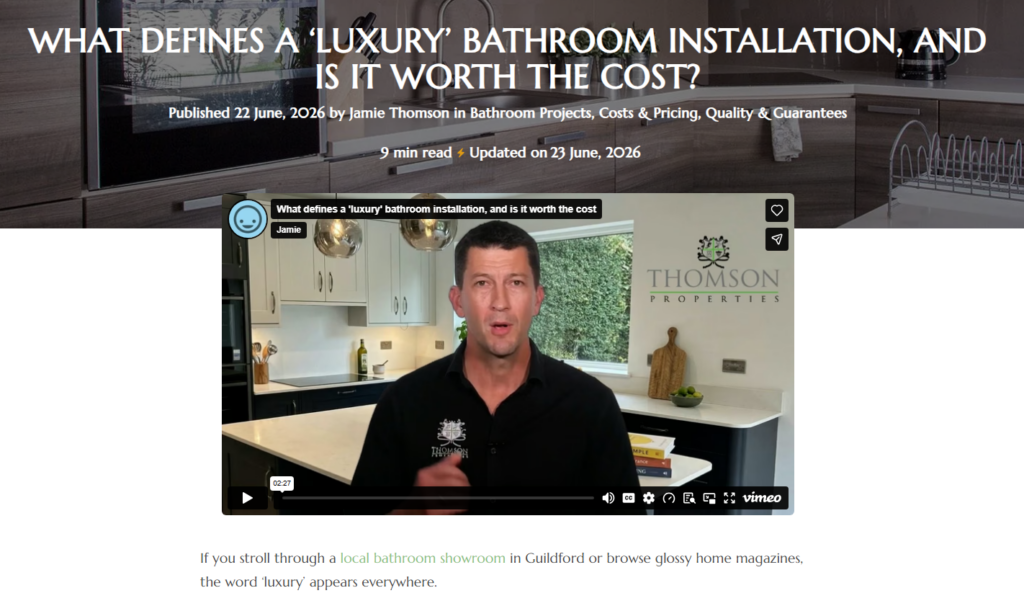
Don’t take my word for any of this. Jamie Thomson’s avatar is live on the Thomson Properties Knowledge Centre, and this article on reliable bathroom fitters in Cranleigh has him presenting it at the top.
Jamie’s is the example I point people to most, and here’s why.
He isn’t comfortable on camera. Never has been. So before this, he produced no video at all. Not a single one.
Not because he doubted it would work. Because standing in front of a lens and being any good at it is a skill, and it simply isn’t one of his.
Now he makes videos whenever he wants to. And he never has to stand in front of a camera again.
What does it bring to your Knowledge Centre?
Your Knowledge Centre is a sales tool before it’s anything else. It answers the awkward questions buyers ask late in their decision, across the five subjects Marcus Sheridan calls the Big 5. Cost. Problems. Comparisons. Reviews. Who’s genuinely best.
Now picture those answers coming out of your mouth rather than off a page. Three things shift.
Buyers who don’t read still get the answer. Plenty of them would far rather watch you for two minutes than read for eight. Right now that group lands on your site and gets nothing from you at all.
Sales calls start further along. Sheridan’s figures from his own company, River Pools, and these are their numbers rather than an independent audit, show buyers who read 30 or more pages closed at around 80%, against 15 to 25% for those who read barely anything. His sales team went from 230 appointments to make 75 sales, to 110 sales from just 140 appointments. Fewer meetings. Better ones.
You stop being a stranger. Craig Stott, who fits bathrooms and has his avatar live, told me his prospects now turn up practically sold. He feels like a bit of a mini-celeb before they’ve even spoken to him.
That’s one client describing his own experience rather than a measured study. But I’ve heard versions of it more than once.
One caveat worth holding onto. None of this works if the articles are weak. The avatar amplifies whatever sits behind it. Waffle gets amplified too.
Are they realistic enough to pass for real?
Nearly. But not quite, and here’s the story that puts the line in the right place.
One of my clients had her avatar live, presenting her articles. She got a phone call from a total stranger.
“I don’t know you and I don’t want to work with you, but me and my business partner have got a bet on. I think it’s real, he says it’s not. Which one is it?”
She told him it was AI. They couldn’t believe it.
So, realistic enough that two grown men had a wager on it. But some people will spot it. Some won’t. Set your expectations there and you won’t be disappointed.
What it certainly isn’t is the AI slop you’ve seen. Stiff mouths, dead eyes, robot cadence. That’s what put people off the whole idea, and rightly so.
Should you tell people it’s AI?
Yes. And I’d go further. Say it out loud in the first few seconds, not in the small print. Something like this.
“Hi, I’m AI Sarah, the digital twin of Sarah Bennett. I’m not the real Sarah and I won’t pretend to be. But every word I’m about to say was written by her, from twenty-two years of fitting these things properly. Give me two minutes and you’ll have your answer. Or the full article is just below.”
Look what those four sentences do. They admit what it is before anyone has to work it out. They make clear the expertise is genuinely yours. And they hand the reader a choice.
Why give it away? Because a buyer who watches four of your videos, calls you, and then works out for himself that it was never really you has learned something about you that no amount of good content repairs.
A buyer who’s told upfront and watches anyway has learned something different. That you’re straight with people.
Where do I recommend using it, and where is it your call?
Fair challenge first, because I get it a lot. My whole business is about helping good UK businesses stay human in an age of AI. Then I turn up with an AI video of your face.
Here’s how I square that. Film real video whenever you can. A wobbly phone video of you being straight with people beats a polished avatar every time.
But look again at those eight bottlenecks. For most owners the choice isn’t real video or AI video. It’s AI video or no video at all.
Most businesses are using AI to sound like everybody else. You’d be using it to look and sound more like yourself.
So here’s my honest split.
Recommended without hesitation. Summarising your Knowledge Centre articles. That’s what it’s built for, and it’s where the volume problem bites hardest.
Entirely your call. The rest of your website. Homepage, service pages, about page. Some clients put the avatar everywhere. Others decide the homepage should be the real them, filmed properly, and keep the avatar to the Knowledge Centre. Both are sound choices.
And you can try it and see. Put it live, leave it a month, watch what happens. Don’t like the results? Film a real version and swap it over. Or the other way round. You’re testing, not committing.
What do you get, and what does it cost?
The process is short. We sit down and I get what’s in your head out of it. We capture a short piece of video of you, once, and that’s what your avatar is built from. I write the articles. Your avatar presents each one. You keep the lot.
Once. That’s the whole point of it. One recording, and you never do it again.
Unless, of course, you want to update your look, but potentially that is something that just happens once a year or once every two years. It depends how invested you are.
The avatar is included in every Knowledge Centre build at no extra charge from me, along with a video summary at the top of every article I write for you. Builds run from £4,980+VAT to £19,995+VAT (including 30, 60 or 100 articles) depending on how much of your market you want covered, and the cost page breaks down exactly what moves that figure.
Two costs that don’t come to me. The platform charges roughly £45 a month, paid directly to the provider and affected by exchange rates. There’s also an optional one-off upgrade to the latest avatar technology, between £100 and £300 depending on the size of the build. I recommend it for the sharpest result. It isn’t required.
You own the avatar from day one and you keep it when the project ends. Which matters, because the technology is moving quickly. What I can build today is a long way beyond what I could build two years ago, and you’ll be able to enhance yours again next year without starting from scratch.
So when my work finishes, you’ve still got a way to make a video of yourself in minutes. Which opens up a few things.
- Article summaries forever, for anything you or your team write from here on.
- Marketing. Social posts, ad creative, campaign videos, at whatever volume suits you.
- Training videos, built in an afternoon rather than needing a film crew.
- Personal video emails in sales, which Sheridan rates as one of the biggest free upgrades available to any sales team.
- Other languages, with matched lip movement, so you can talk to a market you’d otherwise have to film all over again for.
Every one of those is the same bottleneck removed somewhere else in your business.
Who is this genuinely not for?
- You want an avatar and nothing else. I don’t sell it separately. Without articles behind it, you’ve bought a talking head with nothing to say.
- You won’t say it’s AI. If the plan is to pass it off as real footage, we’d be building the opposite of what I build.
- You won’t put your own face forward. A perfectly legitimate choice, and it makes this pointless.
- You need it flawless. If “some people might tell” is a dealbreaker, don’t do it.
- You’d genuinely film all sixty videos yourself. Some owners would. If that’s you, do that instead. It’s better, and it’s free.
- You won’t feed it afterwards. It’s a sales tool you feed, not a slot machine you pull.
If two or more of those landed, save your money for now. I’d rather lose the work than build you something you won’t use.
And who is it a perfect fit for?
- You sell something considered, and buyers research you for weeks before they make contact.
- You’re the trusted face of the business, or your lead salesperson is.
- You’ve known video would help for two years and still haven’t filmed any.
- You’re willing to be transparent about price and about who you’re not right for. That’s the raw material.
- You’re the best-kept secret in your market and you’ve had enough of it.
Recognise yourself in most of that? Then only one thing is still in the way.
So is it worth it? The difficult bit
Everything above treats this as a logistics problem. Eight obstacles, all eight removed.
But logistics was never really the blocker. It’s that putting your face on your website, publishing your prices, and admitting who you’re not right for takes nerve. Far more nerve than signing an invoice.
I’ve watched owners with the avatar built and ready sit on it for weeks. Nothing to do with the technology. Everything to do with what it means to be visible.
And that nerve is exactly what earns you the trust, because your competitors haven’t got it.
So answer these five honestly.
- Would a buyer who’d watched you answer three of their biggest questions arrive at a call warmer than one who read nothing?
- Have you spent six months or more meaning to record video, and not recorded any?
- Are you willing to say on camera that it’s an AI version of you?
- Will somebody in your business actually send these articles and videos to prospects before calls?
- Are you prepared to publish your prices and your limitations honestly?
Four or five yes. Worth it, and a conversation is worth your time.
Two or three. Something needs sorting first, usually question three or five. Read what a Knowledge Centre actually is and come back when you’re clearer.
Nought or one. Not worth it. Not now, possibly not ever, and that’s a perfectly sound answer. Save your money.
The questions I get asked most
I hate being on camera. Is that a problem?
No, and you’re in the majority. There’s one short recording at the start, and most people who dread it are fine once they get going. After that, you never do it again. Jamie Thomson had produced no video at all before this for exactly that reason.
Can I see one before I commit? Yes. Go and watch Angela Cox’s Knowledge Hub at paseda360.com and judge for yourself. That’s the fairest test I can offer you.
Does it replace me on sales calls? No, and I’d be worried if you wanted it to. It gets a buyer to the call better informed. You still have to be good in the room.
Is it worth it if I’ve only got a handful of articles? Honestly, less so. The value is in the volume. One video is easy enough to film yourself. Sixty isn’t.
Will it definitely make people trust me more? No guarantee. It improves the odds, because a face and a voice do a job that a page of text can’t. But if the content behind it is thin, video won’t rescue it.
Can’t I just do this myself with one of the cheap tools? You can, and some people get away with it. But the gap between “an avatar” and “an avatar that doesn’t make people wince” is wider than the marketing suggests, and getting it wrong damages trust rather than building it.

Where that leaves you
A mistake of mine, before you decide. For the first couple of years I treated the avatar as a nice extra on top of the articles. Took me longer than I’d like to admit to work out I had that backwards. It isn’t decoration. It’s the thing that removes the reason the video never got made.
So. You already knew video would help. Eight obstacles beat you to it, and an avatar clears all eight. What it hands back to you is the one decision it can’t make for you, which is whether you’re ready to be visible.
It isn’t a stand-alone product. It isn’t indistinguishable from the real you. And it’s no substitute for filming yourself if you’ll genuinely do it.
You’re also allowed to do nothing about this. If your diary is full and the idea of your face on your website makes you uncomfortable, close this page with a clear conscience. Plenty of good businesses have grown without it.
And if it interests you, book a call with me. We’ll talk about your buyers, the questions they’re really asking, and whether putting you on camera this way is the right move. No pressure, no jargon. And if it isn’t right for you, I’ll tell you.
One thing I’d genuinely like to know when we speak. Which of those eight obstacles is the one that actually stopped you? I’ve got my theories, but I’m always curious whether I’m missing something.
Mark Reynolds builds Knowledge Centres for businesses using the Endless Customers methodology, formerly known as They Ask, You Answer. He was trained personally by Marcus Sheridan and has been implementing this approach since 2013, long before the methodology became widely known. More about Mark.

Related Articles