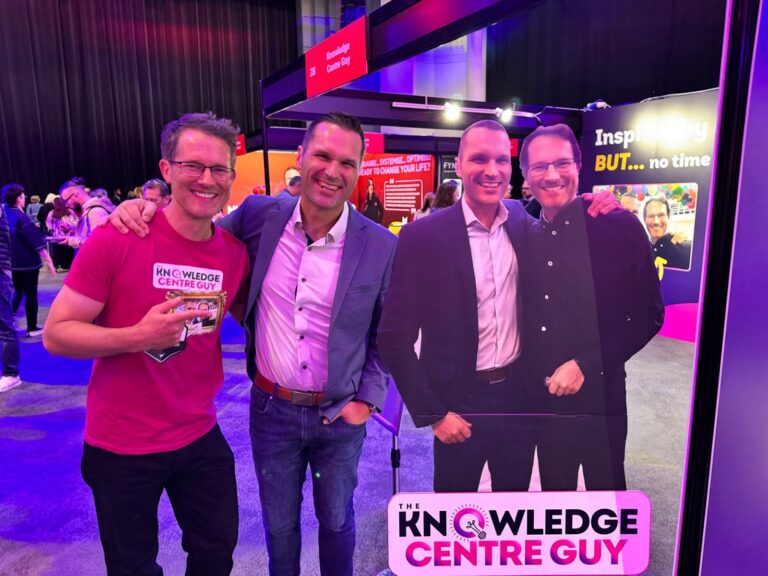
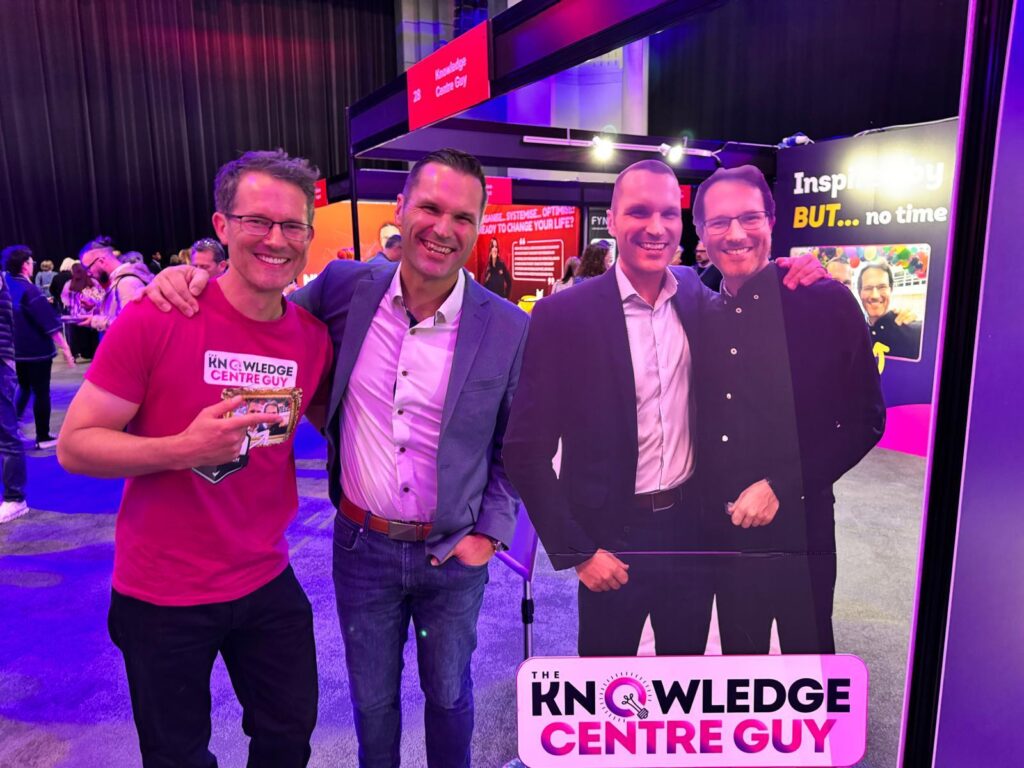
Written by Mark Reynolds – The Knowledge Centre Guy (I’m the one on the far-left and far right above and Marcus Sheridan is the other two! 😂)
You’ve been told to build your whole content strategy around the ideas of an American who used to sell swimming pools. And something’s nagging at you.
You’ve spent money on marketing before that promised the earth and handed you back a spreadsheet. So before you give 10 to 15 hours a week of your own time, or a serious chunk of budget, to a methodology with one man’s name stamped on it, you want to know one thing.
Is he the genuine article, or just another smooth guru with a big story and even bigger numbers?
Short version. Yes, he’s worth listening to. But not for the reason everyone repeats.
You’ve probably heard that one article on his website generated over $35 million in sales. That figure is real. It’s what his old pool company tracks in their HubSpot CRM as sales that single article has influenced over more than a decade.
And back in 2013, the New York Times independently reported an earlier slice of the same story, $1.7 million traced to one pricing article. So the headline number holds up, and an outside source confirmed the engine behind it years ago.
His method isn’t original, mind. What’s different is the discipline, plus one idea that changes everything. Treat your content as a sales tool, not a traffic toy.
So you know exactly where I’m standing. I build Knowledge Centres using Marcus Sheridan’s methodology. He trained me personally. I’ve been doing this since 2013, six years before his work was a bestseller (you can read more about me and how I got here if you want the full story).
Which makes me writing “is Marcus Sheridan worth listening to?” – yes I’ve got a conflict of interest, and you should read everything below knowing that. I know Marcus, he trained me directly to implement his framework, but I’m fully independent and wanted to give you a balanced guide to Marcus, who he is and is he worth listening to (for some yes, for others no) I’ve tried to write it as though I didn’t know him.
Right. Let’s take your doubts one at a time, and I’ll tell you which ones hold up.

Key Takeaways
- That famous $35 million from a single article is real. It’s tracked through the company’s HubSpot CRM as sales the article has influenced over more than a decade, and the New York Times independently reported an earlier $1.7 million slice of it back in 2013. CRM-attributed influence isn’t the same thing as a one-year audited figure, but it’s a real and defensible way to measure what content does.
- His methodology, now called Endless Customers and formerly known as They Ask, You Answer, isn’t an original idea. It overlaps with HubSpot’s inbound marketing and Google’s own advice on helpful content. The originality is in the discipline, and in answering the questions your competitors are too scared to touch.
- This one works against me. The Knowledge Centre I build for you is about as close to a push-button start as it gets, because I carry the heavy lifting – the in-depth discovery sessions and a world-class writing process. But the foundation is the launchpad, not the finish line. The real transformation goes to the owners who keep building on it – refreshing existing articles, adding new ones, and putting the best of it in front of every prospect. Traffic starts climbing around month four and compounds from there. Treat it as a sales tool you feed, not a slot machine you pull. If you won’t feed it, don’t spend the money.
- Serious people put their names to his work. Donald Miller, the StoryBrand author, endorsed his latest book. So did the founders of HubSpot. That tells you respected operators take him seriously. It doesn’t prove the method works for you. Endorsements are reputation, not evidence.
- Judge him as a sales tool first. The proof that holds up is about close rates and sales-cycle friction, not website traffic. If you remember one thing, remember that.
Table of Contents
Is Marcus Sheridan just another American marketing guru?
He started exactly where the cynic assumes. A salesman with a story to sell.
But it didn’t start on a stage with a microphone. It started with a real business that nearly went bust. That’s why it’s worth taking him seriously.
Here’s what happened. Sheridan co-founded a swimming pool company, River Pools and Spas, in 2001. When the 2008 crash hit, homeowners stopped being able to finance pools through second mortgages almost overnight, and the business came within a whisker of going under. PR News reported at the time that he was nearly forced to file for bankruptcy.
He had no money for advertising. So he did the only thing he could afford. He sat down and answered, in writing, every single question a nervous pool buyer had ever asked him.
What does it cost? What goes wrong? Which type is best?
He became, in his own words, “the pool guy.”
And it worked. This is the bit that matters, because an outsider confirmed it. The New York Times reported in 2013 (free account required) that Sheridan had rebuilt his marketing around plain, useful articles and videos, that he’d become known as something of a web marketing guru, and that he’d tracked at least $1.7 million in sales to a single article about pool pricing.
That’s not Sheridan on a stage. That’s a national newspaper checking and reporting it.
So where does the famous $35 million come from? The same article, measured differently. River Pools runs everything through a HubSpot CRM, and over more than a decade that one pricing article has been the first touch on deals worth, cumulatively, over $35 million in influenced sales.
One number is a newspaper’s snapshot from 2013. The other is a long-run total of every deal the article has had a hand in since. Both describe the same engine. The difference is just the measuring stick, and it’s worth understanding which is which so nobody can accuse you of repeating a fairy tale. It isn’t one.
The claim I’d treat with a touch more care is “the most visited swimming pool website in the world.” It’s repeated everywhere, including by trade press, but I couldn’t find independent traffic data proving it. Hold that one loosely. It doesn’t change the substance.
Does any of this make him a guru in the eye-rolling sense? Not really. A man can have a genuinely transformative, CRM-tracked, newspaper-confirmed result and let the odd reputation line run ahead of the evidence. That’s a far better record than most of the people charging you for marketing advice.
Isn’t this just common sense in a fancy wrapper?
Partly, yes. And anyone who tells you otherwise is overselling.
The core idea – listen to your buyers, answer their questions, be transparent, make genuinely useful content – is not something Sheridan invented. The fairest critics say so.
On Goodreads, plenty of experienced marketers call his first book repetitive, basic, “101” stuff. They’re not wrong. It overlaps heavily with HubSpot’s definition of inbound marketing, and with Google’s own published guidance, which tells anyone who’ll listen to create people-first, helpful content that shows real experience and expertise.
None of that is a Sheridan original. So where’s the actual value? Two places, and they’re the reason I bet my business on it rather than on inbound marketing generally.
First, the uncomfortable questions. Most businesses will happily write a cheerful “ten reasons to choose us” piece. Almost none will write an honest one about their own pricing, their own drawbacks, or where a competitor might genuinely be the better fit.
That’s the content buyers actually want and can never find. Sheridan won’t let you dodge it. He groups it under a heading he calls the Big 5 – cost, problems, comparisons, reviews and best-of lists. The topics aren’t novel. The insistence on doing the scary version is.
Second, and this is the big one, Assignment Selling. Most content gets published and left to fend for itself in Google. Marcus treats every article as a sales asset your salesperson actively sends to a buyer before a call.
The buyer turns up educated. The objections are half-handled already. The bad-fit buyers have quietly removed themselves. He teaches a set of sales videos for the same job, which he calls the Selling 7.
Here’s where the “common sense” sneer falls apart, because he’s got the numbers.
Sheridan reports that buyers who consumed 30 or more pages of his website closed at around 80%, against 15 to 25% for those who’d barely read anything. Better still, look at what it did to his sales team’s workload.
In 2007, before the content, River Pools needed 230 sales appointments to land 75 sales. After it, they made 110 sales from just 140 appointments.
Fewer meetings. More sales. Far less time wasted on people who were never going to buy.
(Worth flagging, those are River Pools’ own internal figures, not an audited study. But they’re specific, they’re consistent with what I see, and they describe a sales mechanism rather than a traffic fluke.)
His latest book, Endless Customers, boils the whole philosophy down to four things a trusted business does. It says what others won’t say. It shows what others won’t show. It sells in ways others don’t. And it stays genuinely human.
Read those back. There’s nothing in there you couldn’t have thought of yourself.
That’s rather the point. The trouble with common sense is that almost nobody has the nerve to act on it. The value isn’t a clever new idea. It’s the discipline to do the obvious thing your competitors keep flinching away from.
Where’s the proof it works beyond his pool company?
The right question. And the honest answer has a soft spot in it that you should know about.
Sheridan grew his teaching brand, The Sales Lion, from 2009, then merged it with the agency IMPACT in 2018, where he’s now a partner in a 60-plus person business. That’s the engine that has rolled the method out well beyond pools.
But most of the named success stories you’ll find come from IMPACT itself, which means they’re promotional rather than independently audited. But that’s often the case with case studies – nothing surprising there. They have a strong reputation to uphold, but we always have to be careful with case studies as in general they ignore the other companies who fail. But again that’s the same across the board and not a surprise.
Let’s take a closer look, for example, they report that an American insurance firm, Berry Insurance, brought the method in-house, hired a content manager, published three articles a week, and saw 183% business growth, a 99% jump in leads, and a 69% rise in close rate, with website-attributed revenue climbing from $66,000 to $185,000 in a year. A roofing company, RoofCrafters, is reported to pull around $270,000 a month from organic leads.
There are named examples across insurance, roofing, sheds and software. Useful for showing breadth.
The bigger claims, that the method has helped thousands of businesses or driven over a billion dollars in impact, live on promotional pages. Treat those as marketing until someone audits them. But from my experience of Marcus; he and his company have always seemed legit. He goes across the world, speaking on stage, talking directly to businesses owners/fans, and I know from talking to him that he hears first hand the stories of transformation and change. He also sees this in all the 5-star reviews of all versions of the book – so the claim “helped thousands of businesses or driven over a billion dollars in impact” is not surprising.
I’d rather show you proof you can poke at yourself, from my own work here in the UK. (If you’ve never seen what one of these looks like, here’s what a Knowledge Centre actually is, and my own one is built on exactly the principles I’m describing.)
I built the Knowledge Centre for Bristol Bifold in 2013. One article ranked number one in the country for “Top 5 Do’s and Don’ts When Choosing a Bifold Door.” The business grew past £1 million in annual sales.
And here’s the part I trust most, because it didn’t come from me. When the company was sold, the buyer’s due diligence team – people whose whole job is to be sceptical and find reasons to pay less – valued what I’d built at £500,000 a year in revenue.
A hostile audience, reaching a positive verdict. It still runs today, with the original owner nowhere near it.
Then there’s Phil Coleman at Barlow Blinds. His site was getting 400 visitors a month. Like Marcus, he sat down and wrote the articles, transforming his monthly visitors from 400 to 40,000. He binned his Google Ads entirely because the organic traffic made them pointless. One piece of work generated over £1 million in revenue, and his average sale went up 44%.
And I want to be clear with you. Phil is not my client. He did that independently, using the same approach. I mention him precisely because it proves the method works regardless of who builds it. (A far stronger claim than “it works when I do it.”)
Now the difficult middle, because every honest case study has one. None of this happened in 90 days. Having said that, after I launch my knowledge centers I commonly see a good increase in buyers coming to the website after month 4.
How fast you see movement depends on you, and on a few things nobody fully controls. Your industry. The state of your website. How well known your brand already is. How much Google already trusts your domain.
Two businesses can do identical work and see different timelines, and anyone who promises you a fixed date is guessing. What I can tell you, because I see it again and again, is that strong traffic progress from Google often starts showing up around month four. Traffic first. Leads follow. (Whether the done-for-you route is even right for you is a fair question, and I’ve written honestly about who it suits and who it doesn’t.)
And here’s one more thing. Month four is a start line, not a finish line. I can hand you a foundation built to a standard most of your competitors will never match, almost push-button on your end. But the businesses that genuinely pull away are the ones that keep it alive – updating articles as buyers’ questions change, adding new ones, and actively putting the best of it in front of every prospect before a call. The build is the easy part, because I do it. The transformation comes from treating it as the sales tool it is.
The months before that are the hard part. They feel like nothing’s happening.
I once sat with an owner in month three who was frustrated, because the numbers hadn’t budged and the doubt was deafening. The work was sound. Foundations just happen to be invisible while they’re being laid. By month five the trend line had turned, and a year on it was transformed.

If anyone shows you a case study that jumps straight from “stuck” to “thriving” with no dip in between, they’ve quietly edited out the truth.
So, proof beyond the pool company? Yes, across enough industries and countries that this clearly isn’t a one-off. Is most of the quantified proof promotional rather than independently audited? Also yes. Hold both in your head.
Is Marcus a bestseller, or is the book a best-kept secret?
He’s a genuinely well-published author with real credibility. His “bestseller” status is part verifiable and part the kind of claim you should hold loosely. Let me split them.
The solid part. Wiley, a serious professional publisher and not a vanity press, published They Ask, You Answer in 2017, a revised edition in 2019, and the follow-up, Endless Customers, in April 2025. Wiley doesn’t put its name on just anyone.
The first book carries thousands of strongly positive ratings, sitting around 4.8 on Amazon and 4.2 on Goodreads, and Sheridan’s site says it’s sold over 100,000 copies. That last figure is his, not an audit, so file it under credible but self-reported.
The part to handle with care is the phrase “national bestseller” on the marketing for Endless Customers. The book does show strong category rankings on Amazon, climbing into the top spots in business, marketing and web-marketing categories around launch.
But a high Amazon category rank and a named national list placement, the New York Times or Wall Street Journal kind, are two different animals. I went looking for the second. I couldn’t find it in the public record.
That doesn’t make the claim false. It makes it unproven, and you should treat a “bestseller” badge the way you’d treat any badge a company prints on its own packaging.
Which brings us to whether Endless Customers is some kind of “best-kept secret.” Honestly? I’d retire that phrase. It’s a newer book with far fewer public ratings than its predecessor, and its strongest early reviews tend to come from people already inside Sheridan’s world.
That’s not a secret. That’s just a book early in its life. “Still building its reach” is the fair description.
Does anyone serious actually back him?
Yes, and this is the part I’d put real weight on, because it’s harder to fake than a sales figure.
Donald Miller, the man behind StoryBrand and one of the most respected marketing authors alive, put his name to Endless Customers. He didn’t do it grudgingly either. He framed Sheridan’s work as what you do after you’ve clarified your message, the execution engine that actually gets a business found by buyers.
When a peer of Miller’s standing backs your book directly rather than politely, it tells you something. (And the respect runs both ways. Sheridan openly teaches StoryBrand as the perfect partner to his own method. Miller gives you the words. Sheridan gives you something worth saying and a way to use it.)
He’s not the only one. The founders of HubSpot, its chief executive; Gino Wickman of Traction and EOS, and marketing author David Meerman Scott all sit among the names attached to his work. That’s a serious room of people willing to stake their reputations on him.
It’s the same story on stage. Marcus Sheridan has delivered 750-plus talks, commands somewhere around $20,000 to $30,000 a keynote, and is widely described as a Forbes “20 Speakers You Shouldn’t Miss The Opportunity To See“.
Closer to home, he keynoted the National Entrepreneurs Convention in 2025 to over 1,200 British business owners – the most understated and sceptical audience there is – and held the room.
Now the caveat, because it matters. Endorsements and speaker fees are still marketing assets. They prove respected people believe in him and that organisers will pay to book him. They don’t prove the method’s been tested in a lab. Let them raise your confidence. Don’t let them end your thinking.
Does he ever admit he’s wrong?
This is the test most gurus quietly fail. Confident people aren’t keen to stand up and say “I got that wrong.”
And Sheridan does, more than I expected. He’s admitted publicly that his biggest mistake was an ego-driven push to open physical pool showrooms, which nearly sank the company in 2008, and that his early agency content was “socially cool” yet pulled in zero leads until he scrapped it for answering real buyer questions. (You’ll spot more on his LinkedIn.)
He’ll reverse his own teaching, too. In They Ask, You Answer, the rule was strict – never put your own company on a “best of” or competitor comparison list, because naming yourself looks self-serving and wrecks your credibility with a human reader. He practised it, even leaving River Pools off his own list of the best pool builders in his area.
In Endless Customers, he’s reversed it. AI engines like ChatGPT now scrape those “best of” lists to decide who to recommend, so the new advice is to include yourself, to teach the AI you’re a serious player, while writing it objectively enough that a human still trusts it. That’s not quite him admitting he was wrong. It’s him updating a position in public when the ground shifted underneath it – which is the healthy version of the same thing.
So he’ll own a mistake and change a position when the evidence shifts. The one thing I’d still like to see more of is him taking on a serious critic head-on, in public. But on willingness to be wrong, he scores better than most in this game.
I’ll hold myself to the same standard. I’ve got plenty wrong.
The one that still stings happened early on, when I let a client publish a batch of articles that were technically fine. Well written. Right topics. Properly structured. And completely toothless.
They dodged every uncomfortable question. No real prices, no honest comparisons, no admitting where the client wasn’t the right fit. I told myself it was a reasonable start. It wasn’t. It was a year of effort that built almost no trust, because I’d let them produce the comfortable version of the method instead of the real one.
I don’t do that anymore. If you work with me and you won’t say the hard things, I’ll tell you before we start, not after.
That’s the test for any teacher, including the one whose method I sell. Not “are they confident?” but “do they hold themselves to the standard they set for everyone else?”
Is this just a clever way to sell more content?
Partly. And I won’t pretend otherwise. Sheridan’s world includes books, coaching, software and a full agency. There’s an obvious commercial funnel, and you’re standing in a version of it right now, reading this.
So is the education just a thin wrapper round a pitch? I don’t think so. Here’s the test I’d apply.
A pure funnel gives away as little as possible to get you on a call. Sheridan and his agency IMPACT publish a huge amount of genuinely useful material for free, and his old pool company’s articles, the ones that started all this, are still sitting there teaching people how to buy pools, sometimes from competitors.
That’s not the behaviour of someone hoarding value behind a paywall. The free education is real, even though the funnel is real too.
The deeper point is about the alternative, which is worse.
The reason your content probably hasn’t worked isn’t that you bought the wrong tool. It’s that you, like nearly everyone, produced noise.
Quick gut-check. Think of any article or post you’ve had made. If we deleted it from the internet tomorrow, would anyone lose a single piece of genuinely useful information?
For most business content, the honest answer is no, because it says the same thing as ten pages that already exist. Your buyers can tell. Google can tell. The AI tools can tell. They’re all getting better at filtering it out.
And it’s about to get much louder. If someone offers to generate your content in twelve minutes, think about what twelve minutes buys. No research into your actual industry. No real stories from your business. No clue what your buyers are genuinely frightened of.
That’s not content. It’s more noise tipped into an ocean that’s already drowning you.
The stuff that survives, the stuff that earns a recommendation from a human, from Google, or from an AI, is the content that couldn’t exist without the person behind it. Your real prices. Your honest opinion. The story of the client who nearly walked but didn’t, and why.
Sheridan’s method forces you to produce exactly that, and no twelve-minute tool can fake it.
So is it a funnel? Yes. Is the thing it’s funnelling you towards more valuable than the alternative you’d otherwise buy? Also yes. I’d back that even if I weren’t standing in the funnel myself.
Does the “get recommended by AI and Google” angle actually work?
The logic is sound and the direction is right. But I’m going to be more careful here than most of the marketing around this, because the evidence for the original sales idea is far stronger than the evidence for the shiny new AI promise.
Start with what’s well supported. The way people buy has genuinely changed, and the data backs it.
Gartner’s research on B2B buying finds that most buyers now prefer to research without speaking to a salesperson at all, that a large share use AI to skip early sales conversations, and that the typical decision now involves six to ten people and a sales cycle around a quarter longer than five years ago. The Edelman B2B thought-leadership research adds that nearly 90% of buyers had a purchase stall in the past year.
In that world, a website that honestly answers every question – one a buyer can read and forward to the rest of their committee at 11pm without booking a meeting – isn’t a nice-to-have. It’s how the deal moves at all. Sheridan’s Big 5 content maps almost perfectly onto that behaviour. I’ll defend that part hard.
Now the caution. The newer pitch, that this kind of content reliably makes ChatGPT or Google’s AI recommend your business by name, is plausible but not yet proven consistently for every website. Google’s guidance does reward clear, helpful, trustworthy answers, and it’s reasonable to expect AI systems to favour the same.
A Big 5 Knowledge Centre aligns with Google’s helpful-content guidance and with emerging evidence about AI visibility. It can improve the conditions under which AI systems may cite or recommend a brand.
But I have not seen solid, audited evidence that a Big 5 Knowledge Centre consistently causes an AI engine to name a company. The alignment is real. The proven causation isn’t there yet. That is why I’ve used my knowledge and experience and that of Marcus Sheridan into writing world class Big 5 topic articles for my clients – maximising the likelihood of success. (If you’re curious where you currently stand, Is AI Recommending Your Small Business? walks you through how to check.)
So here’s my steer, and it’s the spine of this whole article. Don’t buy this as an AI lottery ticket. Buy it as a sales tool – with the significant side effect of success in Google and AI powered search. It’s real and I see it with my clients.
The thing that’s independently verified, that’s held up for over a decade, that I’ve watched work with my own clients, is the sales mechanism. Educated buyers close faster, at higher rates, with less friction, and your team stops answering the same five questions on every single call.
The AI visibility is a likely bonus on top. Make AI recommendations the reason you do this and you’re betting on the least-proven claim. There are many factors that determine the success of a company and the Knowledge Centres I produce give you the best chance in the world of achieving success. My advice – make sales enablement the reason and you’re standing on the firmest ground there is, and you get the AI upside anyway. Marcus says focus on ROI from using your Knowledge Centre in your sales, while you’re waiting for the increase in buyers from Google/AI powered search.
How does his approach compare to everything else?
Fair question. Marcus didn’t invent this field, and he’s not the only one in it. Here’s how I’d place him against the methods you’ve probably already been pitched.
HubSpot’s inbound marketing is the broad church his approach lives inside, attract buyers with useful content instead of chasing them with ads. Sheridan is a more prescriptive, more uncomfortable, more sales-obsessed version of it. If inbound is the philosophy, his Big 5 and Assignment Selling are the specific instructions. Related, not rival.
StoryBrand, Donald Miller’s framework, is about clarifying your message so buyers understand you. Sheridan is about answering buyers’ questions and wiring those answers into your sales process. Different jobs, which is exactly why Miller endorses him rather than competing. I use both. And I thread the StoryBrand framework into my work in the Knowledge Centres I produce.
Traditional SEO chases rankings and traffic. This is where Sheridan is most different, and it’s the comparison that matters most for you. An SEO-first team asks “will this rank?” Sheridan asks “can my salesperson use this on a call tomorrow?”
If a pricing article never troubles Google’s front page but closes three deals because the sales team sends it to every prospect, an SEO team calls that a failure and Sheridan calls it a win. That reordering of priorities is the single biggest reason I follow his method over generic SEO advice.
Thought leadership, the big-idea content shown to sway buyers long before they’re in a buying cycle, works, but it leans on you having a genuinely novel point of view. Sheridan’s method needs only that you answer real questions honestly. A far lower and more reliable bar for most businesses.
Account-based marketing treats a handful of high-value accounts as a market of one. Powerful for big-ticket B2B, but it’s about targeting and personalisation, not scalable answers to the questions every buyer asks. Different tool. They can run side by side.
The pattern across all of them is simple. Sheridan is most differentiated against a traffic-and-rankings SEO mindset, and least differentiated against the whole history of inbound marketing. He’s not a revolutionary. He’s the person who took a known principle and turned it into a sales discipline most teams will actually follow. That’s the difference.
Who Marcus Sheridan’s method is genuinely NOT for
This is the part most businesses skip, so I’ll be specific. Marcus Sheridan’s approach is the wrong call for you if any of these is true. Not “proceed with caution.” Wrong.
If you need leads this quarter and can’t wait. I told you about the invisible months. If a project that asks for patience is a non-starter right now, cash is tight and you need the phone ringing in weeks, then put your money into something faster, like paid ads, and come back when you can think past the next 90 days. I’d rather lose the sale than watch you quit in month three having burned the budget.
If you won’t be genuinely transparent. This is the heart of what Sheridan asks of you. Publish real prices, write honestly about your own drawbacks, admit in print where a competitor is the better fit. If that thought makes you want to close the tab, if you’d insist on the polished, comfortable version, his method will fail in your hands and it’ll be the toothless version’s fault, not his. I’ve watched it happen. I won’t set you up for it.
If nobody will own it. Sheridan’s method needs a human owner giving it real, protected time, 10 to 15 hours a week of genuine expertise, not “I’ll get to it on Sunday night.” Or it needs handing to someone who’ll do it properly, and paying for accordingly. A business where the content is everyone’s job, and therefore nobody’s, will produce noise. Noise is the problem you already have.
If you’ve nothing distinctive to say. If you’re a pure price-competing reseller with no real expertise and nothing a competitor couldn’t say word-for-word, transparency about your “expertise” won’t help, because there isn’t any to make visible. Sheridan’s method amplifies genuine expertise. It can’t manufacture it.
Who this IS a perfect fit for
Now the other side, because I won’t leave you on the negative.
If you read that list thinking “none of those are me”, lean in. You’re exactly who Marcus Sheridan wrote the book for. A genuinely good business that’s somehow still its market’s best-kept secret. Excellent, and invisible.
You’ve got real, deep expertise that twenty years gave you and your competitors don’t have. You sell something considered enough that buyers research it carefully before they ever pick up the phone. And you’re confident enough in your business to tell the whole truth about it, because when buyers see you’ll say the awkward thing, they believe you about everything else.
If that’s you, this isn’t a gamble. It’s the most natural fit there is.
A difficult truth about your situation
I want to say something most articles on this won’t, and I’m saying it because I care more about you getting this right than about you liking me.
Some of the reason your content hasn’t worked isn’t the agency, the tool, or the methodology. It’s that you’ve been unwilling to say the uncomfortable things – the very thing Sheridan built his whole method around – and on some level, you’ve known it.
You’ve kept your prices off the website because a competitor might see them. You’ve avoided the honest comparison because it felt like handing buyers a reason to leave. You’ve produced the safe, professional, forgettable version because the brave one felt risky.
I’m not saying that to shame you. It’s the most common pattern I see, and it comes from a perfectly reasonable fear. But the safe version is the expensive one. It’s the version that produces a year of effort and no trust.
The transparency that scares you is the entire engine. If that’s been your real blocker, not budget, not time, but nerve, then no methodology fixes it until you decide to. Sheridan’s, mine, or anyone’s.
Is this right for you? A self-assessment you can do tonight
Before you decide whether Marcus Sheridan’s playbook is for you, run through these honestly. Nobody’s watching.
- Do you have genuine, hard-won expertise a competitor couldn’t just copy? Yes / No
- Will you publish your real prices and write honestly about your own drawbacks? Yes / No
- Can you give this six months before judging it, knowing the early months feel like nothing’s happening? Yes / No
- Will someone own it properly, 10 to 15 protected hours a week, in-house or paid for? Yes / No
- Do your buyers research carefully before they buy, rather than impulse-buying on price? Yes / No
Four or five Yes. This is a strong fit. The problems in this article are ones you’re well placed to avoid. The only real question left is whether you build it yourself or get someone who’s done it before to build it for you.
Two or three Yes. Worth a proper conversation, but go in with your eyes open about the specific No you scored. If it was the transparency question or the six-months question, sort that out in your own head first. Those two quietly kill more projects than budget ever does.
One or none. In your situation, this isn’t the right move right now. Spend the money where it’ll work faster, build the genuine expertise Sheridan’s method needs, and come back when more of these turn into a Yes. That’s not a fob-off. It’s the honest answer.
A few hard questions you might still be asking
Do I have to read his books to do this?
Reading the book is the difference between getting the gist and actually getting it. AI can give you a good sense and feel of the method in an afternoon, and that’s genuinely useful. But Marcus’s own observation is that the companies who win biggest are the ones where the leaders physically read the book. You can’t pick up the nuance any other way. So if you’re serious, read the book.
Isn’t he too American? Does this work in the UK?
It works here, and not only because I’ve done it here since 2013. He keynoted the National Entrepreneurs Convention in 2025 to over 1,200 British business owners and held the room. The transparency principle arguably suits Britain better than the States, because British buyers are even warier of boastful sales talk. Honesty travels.
Can’t I just use ChatGPT to write the articles and get the same result?
No, and I say that as someone who uses AI every day. Sheridan’s whole point is that trust comes from a human saying things only a human can say. AI doesn’t know your business, your buyers’ fears, or why that client nearly walked away last year. It produces the same plausible, generic content everyone else’s AI produces, which is the noise problem you already have. AI’s a brilliant tool for dozens of jobs. Building the trust that makes a stranger pick up the phone isn’t one of them.
Should I just hire his agency, IMPACT, instead of me Mark Reynolds?
Honestly? If you’re a large US business that wants the brand-name agency, they’re a serious, capable team and you should talk to them. But for a UK SME, there’s a practical point worth making. I’m very likely a more affordable way to get transformational results than an agency built to serve the whole of the United States – and you get someone who’s hand-built these here for over a decade, knows the British market, and will tell you to your face when you’re not a fit. And I work directly for you, rather than an agency where you could very well be working with a junior. That’s the gap my Done-for-You service fills. Different buyers, different answers. I’d genuinely rather you picked the right one than the convenient one.
What if I read all this and decide he’s not for me?
Then you’ve made an informed decision, which was the whole point. That’s a good outcome, not a failed one.
So, is Marcus Sheridan worth listening to?
On balance, yes. With your eyes open.
He didn’t invent customer education. Some of his numbers are CRM-attributed influence rather than one-year audited figures, and you should know which is which. And I’d still like to see him take on a serious critic in the open. Those are real caveats, and I won’t pretend they aren’t.
But the core idea is independently verified, the method is unusually practical, serious people stake their reputations on it, and the part that matters most for you, it’s a sales tool first and a marketing one second. Educated buyers close faster. That’s held up under scrutiny for more than a decade, including in my own work, with a hostile due diligence team putting a number on it.
So treat him as what he is. Not a prophet. Don’t hand him that. A practitioner who took something most businesses already knew and turned it into a discipline most businesses will actually follow. That’s worth more than originality. Originality is cheap. Doing the uncomfortable thing, consistently, is rare. And rare is what wins.
Want to go deeper before you talk to anyone? A few honest, no-strings places to start.
- Read that New York Times piece I mentioned near the top. It’s the one independent account of where all this started.
- See what a Knowledge Centre actually is and whether a done-for-you one is right for you.
- Get the real numbers on how much a Done-for-You Knowledge Centre really costs (and whether it’s worth it).
And if, after all this, the timing’s wrong or it’s not the right fit, that’s completely fine. No pitch, no PowerPoint. This article will still be here when you need it.
But if you’ve read this far and you’re quietly thinking that “who it’s for” list was basically me – a genuinely good business nobody can find, real expertise going to waste, buyers picking louder competitors who say far less – then the only thing standing between you and being the business Google and AI recommend first is the decision Marcus Sheridan has been urging for over a decade. Start saying the things your competitors won’t.
If you’d like to put Marcus Sheridan’s approach to work in your own business, schedule a 30-minute call with me. We’ll talk about your business, your buyers, the questions they’re really asking, and whether his method is the right move for you. No pressure, no jargon. And if it isn’t right for you, I’ll tell you.

Mark Reynolds builds Knowledge Centres for businesses using the Endless Customers methodology. He was trained personally by Marcus Sheridan and has been implementing this approach since 2013, before the book was a bestseller. More about Mark.