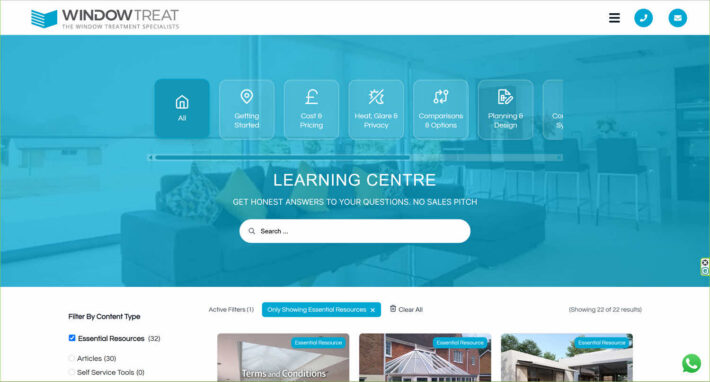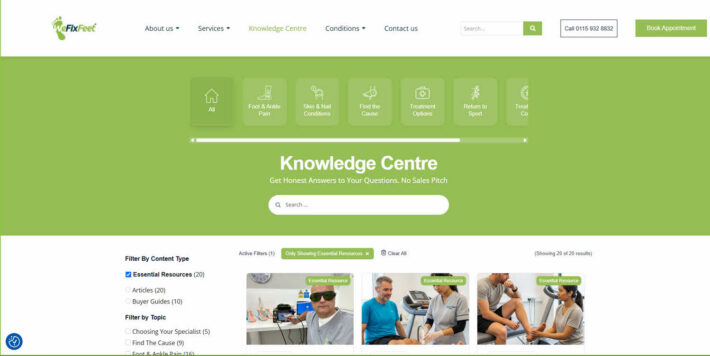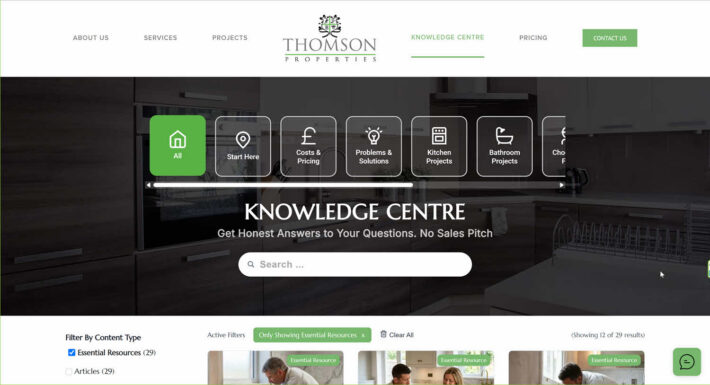
How a North East UK Occupational Health Provider Turned Years of Repeated Sales Answers Into Buyer-First Education. Without Losing the Personal Service That Sets Them Apart.
NPH Group had the expertise. The problem was that most of it only ever came out in a one-to-one sales conversation. Here is how we moved it into the open, where their buyers could find it first.
Client:
NPH Group - Occupational Health and Wellbeing
Project
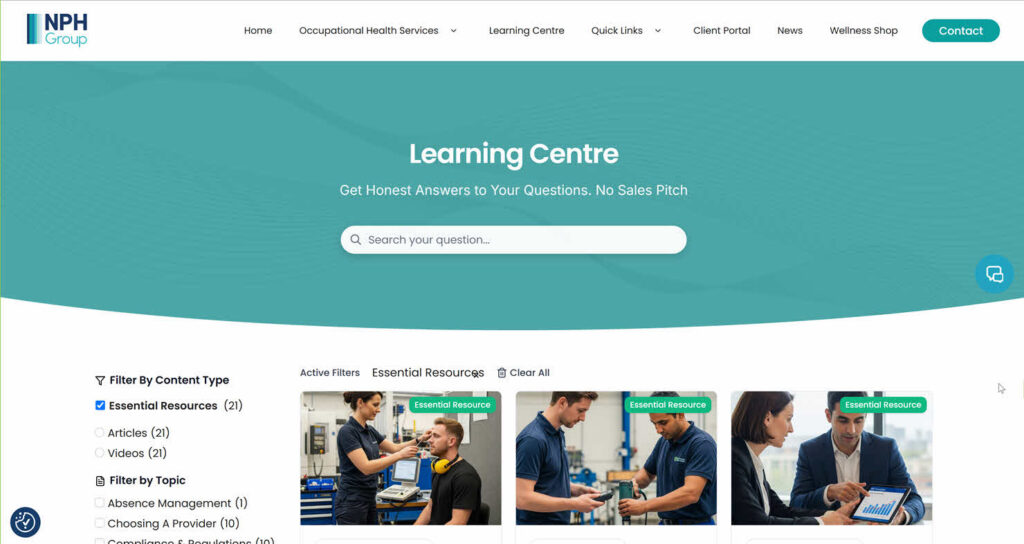
Knowledge Centre + 30x Big 5 Articles + 8x Core Topic Ultimate Guides + AI Digital Twin + 60 photos + 30 Article Summary Videos
Written by Mark Reynolds, The Knowledge Centre Guy
At a Glance
When you visit the NPH Group Learning Centre you may see some articles written by CEO Mark Philpott, and some written by me – Mark Reynolds, The Knowledge Centre Guy. To save you time digging around, here are links below to some of the almost 20 articles I wrote.
When we published NPH’s Learning Centre I had written approximately 20 Big 5 topic articles and of course created their AI digital video twin and 20 AI summary videos.
Big 5 Topic Articles:
| Company | NPH Group |
| Who led it | Mark Reynolds, The Knowledge Centre Guy. Certified Endless Customers Partner. |
| Industry | Occupational Health and Wellbeing |
| Team | Mid-sized provider. Large enough to deliver with resilience, personal enough to still care. SEQOHS accredited. |
| Problem | Deep occupational health expertise lived inside sales conversations. Buyers struggled to understand what they actually needed, what the law required, or how to compare providers, long before anyone asked for a quote. |
| What they did | Built a Knowledge Centre around roughly 20 priority buyer-question articles, chosen from a much bigger bank of real questions. The honest, buyer-first ones first. Also, created AI digital video twin and 20 AI summary videos. |
| Result | Repeated sales explanations turned into clear public education. A sharper, more consistent message. A foundation for ongoing Knowledge Centre growth. Better-informed buyers arriving at the conversation already up to speed. |
| Source | A Knowledge Centre Guy client project. Results are building. Final articles publish on NPH’s sign-off. |
An Expert Team Whose Best Material Only Came Out In Person
Let me paint you a picture you might recognise.
You run a genuinely good business. You know your field cold.
When you get in front of the right person, an HR manager, a health and safety manager, the one in charge of keeping people safe and the company compliant, you can answer every question they throw at you.
The legal stuff. The cost stuff. The “do we even need this?” stuff.
That was NPH Group.
They are an occupational health and wellbeing provider in the North East. They do the serious work that keeps regulated businesses on the right side of the law and keeps their people well.
Employment medicals. Health surveillance. Absence management. Drug and alcohol testing. Health screening. Health promotion.
Their real differentiator is a detailed, role-based needs evaluation they run before a single appointment is booked. No off-the-shelf package.
They look at the actual roles, the actual risks, and they tailor it. Often they combine appointments so a client loses less time and pays for less duplication.
Here is the bit I want you to notice. All of that brilliance only came out when someone sat down with them.
Their expertise behaved a bit like a five-star chef who will only cook if you book a table, turn up, and sit down in front of him.
Wonderful, if you are already in the restaurant. Useless to the hundred people walking past outside who have no idea what is on the menu.
NPH’s buyers were walking past. Not because the food was bad. Because they could not see it yet.
The Problem: Confused Buyers Make Slow, Nervous Decisions
So what was actually going wrong?
Nothing dramatic. Which is exactly why it is so common, and so expensive.
NPH’s buyers are HR and health and safety managers in construction, manufacturing, engineering, transport and education.
Mostly, they do not understand occupational health as well as they would like to. And why would they? It is not their day job.
Their day job is people, or risk, or both. With not nearly enough hours to do either.
The external problem. They could not easily tell the difference between health surveillance and an employment medical. They were not sure what the law actually demanded for a forklift driver versus a machine operator versus someone on a noisy site.
They had been let down before. Cancelled clinics. Reports that dragged on for weeks.
And when they finally found a provider worth a look, they then had to sell it internally. To finance. To procurement. To an MD who only wanted to know one thing. Why does this cost what it costs?
The internal problem. This is the part the brochures never mention.
That HR manager lies awake worrying about an HSE inspection finding a gap she did not know she had. She is anxious about getting it wrong and being the one personally on the hook.
She is tired of chasing employees to appointments. And she dreads justifying a number to a finance director who thinks occupational health is a cost, not an investment.
The philosophical problem. Most of these people genuinely believe businesses should protect their workers properly. They want to do the right thing.
They just cannot work out, on their own, what the right thing actually is.
Now here is the trap that catches almost every business in NPH’s position. The “but we’re different” trap.
“We’re occupational health. We’re regulated. Our buyers are technical. They won’t read articles, they’ll do a formal tender.”
I hear a version of that from nearly every business I work with. (It nearly always turns out to be a comfort blanket rather than a fact.)
So let me hand you the single question that cuts through all of it. The one question worth asking about any piece of content you are scared to publish:
Will this induce more trust?
If the answer is yes, you publish it. Regulated or not. Technical or not. B2B or not.
Because every business, yours included, is in the business of trust before it is in the business of anything else. The accountancy firm. The property developer. The copier company.
The ones winning in markets every bit as “boring” and “regulated” as occupational health are winning because they answered the awkward questions in public.
The ones losing are playing ostrich. Head in the sand. Hoping the questions go away. They do not. They just get answered by a more transparent competitor instead.
And if you do not answer them, other sharks in your market will scrape up the pieces.
Why NPH Brought Me In
Here is the thing about NPH. They did not need someone to teach them occupational health. They are the experts.
They needed someone to get the expertise out of their heads and onto the page. To a world-class standard. At speed. Without it turning into another job that quietly never gets done.
That gap is my whole specialism.
I know how frustrating it is when you have built something genuinely good and the people who need you cannot find you.
I have spent 25 years in SEO, web design and content for UK businesses. More importantly, I am one of only a handful of people in the UK certified to implement Endless Customers by Marcus Sheridan (formerly “They Ask, You Answer”).
I went through Marcus’s 12-month programme personally. I did not read the book and wing it. And I have now built more Knowledge Centres, across more industries, than any other practitioner in the country.
Marcus put it kindly enough that I will borrow his words once:
“If you’re serious about making They Ask, You Answer work, you need to talk to Mark. He doesn’t just teach this stuff, he makes it happen.”
Marcus Sheridan, author of Endless Customers
That last line is the part that mattered to NPH. Makes it happen.
Because most businesses that try this themselves stall. Not through lack of brains. Through lack of determination, time, and an honest editor who will tell them when the article simply is not good enough yet.
Hand it over, and it gets done properly.
One more thing worth saying plainly, since NPH operates with real diligence. A Knowledge Centre is not a blog.
A blog is for company news. The new hire. The charity quiz. The award.
A Knowledge Centre does one job and one job only. It answers your buyers’ real questions. Their fears. Their costs. Their comparisons. Their “is this even worth it.”
That distinction shaped everything we did.The Plan: Three Steps, No Drama
I keep this deliberately simple, because the businesses that win are the ones who can actually picture the path.
1. We talk about your business and your buyers. What are the questions HR and health and safety managers are really asking, in their own words, before they ever ask for a price? We pulled those out and ranked them.
2. I build the Knowledge Centre. Honest, expert articles written in NPH’s voice, the questions most likely to move a sale forward first. Interlinked so they work as one system, not twenty stray pages.
3. Google, AI and buyers start finding the answers. Prospects arrive already understanding occupational health, already half-sold, already trusting NPH before the first call.
For NPH, the starting point was around 20 priority articles. Hand-picked from a far larger bank of buyer questions.
Not random. Not “what’s nice to say about us.” The questions a buyer types into Google at 9pm. The questions they increasingly ask ChatGPT, when they are trying to work this out for themselves.
Cost. Worth-it. What you actually need. What “good” looks like. How to avoid being let down again.
Why Now, And The Objection We Met Head-On
So why did NPH commit, rather than add it to the “one day” pile?
Because the decision is moving out of the room they were strongest in.
More and more, HR managers do 80% of their research before they ever contact a provider. They are reading, comparing and forming opinions in private.
Worse, they are increasingly asking AI tools who to trust. If your honest answers are not out there, you are not in that conversation. Someone else is.
And the objection NPH had to get past, the one you are probably feeling right now, was the “we’re too technical and regulated for this” worry.
Be honest with yourself for a second. Is occupational health really harder to explain in public than insurance? Than accountancy? Than property development?
Because businesses in every one of those regulated, B2B, “but we’re different” worlds have used this exact approach to win.
The accountancy firm that published its pricing so openly it scared off the bargain hunters and put its average sale price up by nearly 40%. The property developers who built their whole reputation on radical transparency.
Trust is a principle. The technology around it changes. The principle does not.
NPH made the call. The honest answer beats the hidden one. Every time.
Success: What The Project Has Actually Delivered
Now, I am going to be straight with you here, because pretending otherwise would make me exactly the kind of marketer this methodology exists to replace.
This is a project where the results are still building. The articles are written and being published on NPH’s sign-off.
I am not going to quote you traffic, rankings, leads or revenue, because I will not put numbers in front of you that have not earned their place.
When there is verified performance data and NPH’s blessing to share it, you will see it here. Not before.
What I can show you is the work, and what the work has already changed:
- NPH’s buyer-facing message is clearer and more consistent. The complexity of six service pillars distilled into language a busy HR manager actually uses.
- We prioritised the questions most likely to move a sale forward, instead of writing whatever was easiest. Cost. Value. “Which services do we actually need.” “How do I build the business case.” “How do I avoid being let down again.”
- Years of repeated, in-person sales explanation now live as public education that does the explaining before the conversation starts.
- Their genuine differentiators, the role-based evaluation, the tailored delivery, the combined appointments that save clients time, are now explained out loud, not saved for a meeting.
- There is now a foundation for ongoing growth. A model NPH can keep building on, not a one-off campaign that fizzles.
- And the tone is unmistakably theirs. NPH describe themselves as “personal, professional, responsive” and as a provider “small enough to be personal but big enough to have an impact nationally.” Those are their own words. The Learning Centre now sounds exactly like that on the page.
Want to see where this road leads when the data has had time to land? Look across the Atlantic.
Berry Insurance, a US firm in an industry every bit as regulated and trust-driven as occupational health, used this same methodology and grew the business by 183%. Marcus documents it in Endless Customers.
The US tends to run a few years ahead of us on this. Which, for a UK occupational health provider moving early, is not a warning. It is an open goal.
What This Means For You
Here is what I really want you to take from NPH’s story. Especially if you are sitting in a “complicated” or “regulated” or “B2B, our buyers are different” business and quietly telling yourself this is not for you.
Your expertise is your most valuable asset. And right now, a lot of it is probably trapped exactly where NPH’s was.
In conversations. In your head. In one-to-one calls you have a hundred times a year and then forget.
Every time you explain the same thing to the same kind of buyer, you are giving away a five-star answer to a table of one. Then letting it go cold.
A Knowledge Centre takes that answer and puts it on the menu, in the window, where everyone walking past can see it. Before they call. Before they tender. Before they ask anyone else.
Not by shouting louder. Not by spending more on ads. Just by being the most honest, most helpful voice in your market.
You have a gift, and you are responsible for sharing it with the world. Make it happen.
NPH decided to. The only question is whether you will.
Ready To Get Yours Sorted Properly?
If you are tired of repeating yourself in sales calls while quieter, more transparent competitors quietly hoover up the buyers you never even got to speak to, let’s have a conversation.
Book a 30-minute call with me and we’ll work out, honestly, whether a Knowledge Centre is right for your business.
While you are thinking it over, a few things worth a read:
- What’s a Knowledge Centre, and is it worth it?
- Is a done-for-you Knowledge Centre right for us?
- Who is AI recommending in your market?
- What a Knowledge Centre costs
- More about me
The questions your buyers are asking are getting answered today. The only thing left to decide is whether they find your answers, or someone else’s.
Project Specifics
-
Knowledge Centre
-
Writing Big 5 Topic Articles
-
Assignment Selling
-
AI Visibility
-
Lead Generation
-
Buyer Education
-
Radical Transparency
-
Founder-led
-
Search Visibility
-
Trust Building