How a Stuck, Plateaued Insulation Company Doubled Its Business Without Outspending the Bigger Players
RetroFoam of Michigan had stopped growing. They were spending more on marketing and getting less back. Then they did one brave thing their bigger competitors refused to do, and doubled the business. Here is exactly how, and why it matters to you even if your business looks nothing like theirs.
They did it themselves:
RetroFoam of Michigan is documented by Marcus Sheridan in his book Endless Customers as a true success story of implementing the same Knowledge Centre methodology. This is not a client of mine. They worked directly with Marcus Sheridan and his team in the USA, and paid a great deal more than my UK service costs. I am a Certified Endless Customers Partner, trained by Marcus and his team to deliver the same approach, and I wanted to show you what it has done for real companies in the UK and the USA.
Project
Big 5 Articles (written in-house) + "Foam University" buyer-question video series + Assignment Selling.
Written by Mark Reynolds, The Knowledge Centre Guy
At a Glance
| Company | RetroFoam of Michigan |
| Who led it | Mark Massey (Owner & CEO), with a dedicated in-house content team |
| Industry | Spray foam insulation and home improvement (sells to homeowners) |
| Team | Small business. Brought content in-house with a dedicated content manager and a general manager who doubled as videographer |
| Problem | Stagnant, plateaued growth. Spending more on marketing every year and getting less back. Out-shouted by bigger, better-known insulation brands |
| What they did | Built a body of in-depth articles answering homeowners’ real buying questions, starting with the one they had been hiding (price). Answered the same questions on video. Used Assignment Selling and shared it widely |
| Result | Doubled the business. A 2,942% increase in organic leads and a 10,109% increase in organic web traffic. Homeowners arriving 80 to 90% educated before the first conversation |
| Source | Documented by Marcus Sheridan and his team. Not a client of The Knowledge Centre Guy. Shared here as proof of the same methodology I build every Knowledge Centre on |
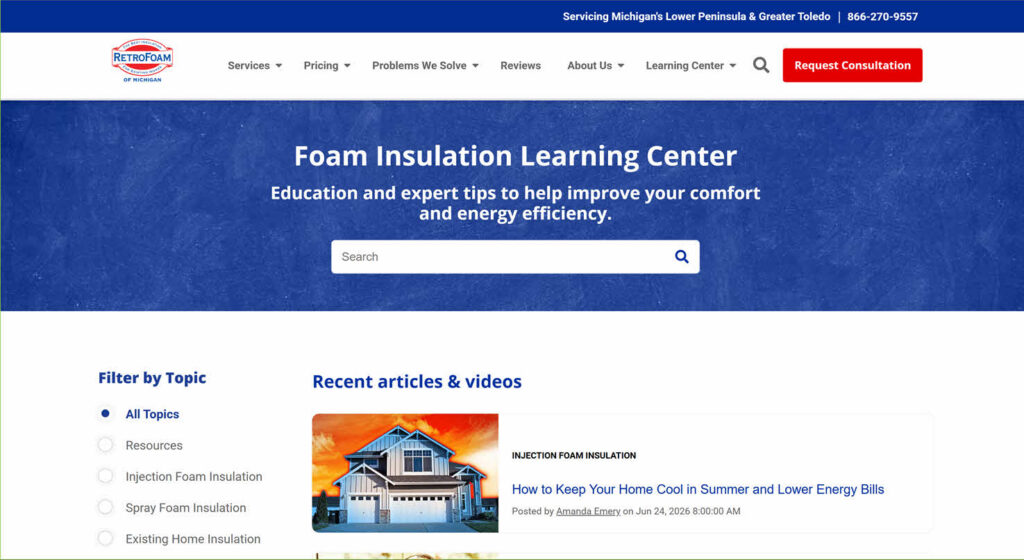
Ever had that feeling where the business just… stops?
You are still working hard. The team is still busy. The money still lands in the account. So why has the growth gone flat? And why, when you actually look at the numbers, are you spending more on marketing than ever and getting less back for it?
That was RetroFoam of Michigan a few years ago. Stuck. Plateaued. Watching bigger, better-known insulation brands hoover up all the attention while they treaded water.
Here is the bit I really want you to notice. They turned it around and doubled the business. Not by spending more. Not by shouting louder. Not by hiring a slicker sales team. Just by being more helpful than anyone else in their market.
Stick with me, because this matters to you even if your business looks nothing like theirs.
First, a quick word about who this story is and isn’t
RetroFoam of Michigan is an American company. They are not my client. They worked directly with Marcus Sheridan and his team in the States, and paid far more than my UK service costs. So why am I showing you somebody else’s win? Because they are a documented success of the exact methodology I build every single Knowledge Centre on.
That methodology is Endless Customers (formerly “They Ask, You Answer”) by Marcus Sheridan. It is the proven, battle-tested approach behind everything I do. I am a Certified Endless Customers Partner, trained personally by Marcus and his team through a 12-month programme, and one of only a handful certified in the entire UK to deliver this for ambitious small businesses.
And here is the opportunity hiding in plain sight. When I was chatting with Marcus, he told me this approach is years ahead in the USA. Over here, far fewer businesses have woken up to it yet. Think about what that actually means for you. The gap in your market is wide open, and the first business to fill it wins. So which is it going to be. You, or the firm down the road?
So what was actually going wrong at RetroFoam?
Their owner and CEO, Mark Massey, is a sharp operator. He goes to the events. He reads. He is forever hunting for the one idea that moves the needle. (Sounds a lot like someone reading this, I would wager.)
But the business had stalled. In his own words, they were not losing ground, they had simply stopped growing, and they were pouring more money into marketing for the same flat result.
Sound familiar?
On the surface, the problem looked simple. Not enough good leads. Underneath, it was far more personal. A company doing genuinely excellent work, being drowned out by bigger brands with deeper pockets. And right at the bottom of it sat the real unfairness. A business that does the job properly should never lose to a business that just spends more on noise. Be honest. Does any of that sting a little?
The one thing they were too scared to do
Then something shifted. Massey heard Marcus Sheridan speak.
One line landed like a punch. Marcus pointed out that business owners shove their pricing in a black box and pray nobody ever looks inside.
That was RetroFoam. Exactly that. The ah-ha moment.
Here is the elephant in the room for nearly every business, yours included. Your buyers want to know what it costs. They want to know where the problems are. They want to know how you really stack up against the other lot. And most companies? They go quiet on the exact questions that matter most.
So the buyer does what you would do. They ask Google. Or these days, they ask ChatGPT. And whoever answers honestly earns the trust, and usually the sale. Let that sink in. The sale goes to whoever is brave enough to answer. Not the cheapest. Not the loudest. The most honest.
What they actually built (and what really did the work)
Now here is the part people get wrong, so I will say it plainly.
The magic was not a clever logo. It was not a shiny new website. It was the articles.
RetroFoam brought a content manager in-house whose only job was to answer homeowners’ real questions, properly and in depth. Their content manager nailed it. Focus on content. Spread yourself too thin and none of it ever gets done.
So they started answering the questions everyone else dodged. What does it cost. What are the problems with foam. How does it compare to the alternatives. The exact things a nervous homeowner types in at 10pm with the heating bill sitting in front of them. Then they doubled down and answered the same questions on video, in a series they cheekily called “Foam University.” Short, specific answers to specific questions.
Here is the bit I really want you to notice, because almost every owner misses it. This is what a Knowledge Centre actually is. A dedicated section of your website, kept completely separate from your blog, that houses in-depth articles answering your buyers’ real buying questions. (Full explainer here if you want it.)
Think about the difference for a second. Your blog is for your news, your opinions, the stuff you want to say. A Knowledge Centre is for what your buyers need to know before they will trust you with their money. One talks. The other earns trust.
And the articles are the engine of the whole thing. The reason businesses come to me, and the part most owners do not realise they are buying, is the articles themselves, and the way they are written so buyers, Google and AI all find them and believe them. The Knowledge Centre is simply how all that brilliant content becomes easy to find.
Done right, that Knowledge Centre becomes the best salesperson you will ever employ. One that works every hour God sends, never takes a sick day, never has an off day, and never once asks you for a pay rise.
RetroFoam did not stop at publishing, either. They pushed that content out across social so their answers reached homeowners before the big brands got a look in. And they used Assignment Selling, sending the right article to a prospect before the sales visit, so people turned up already educated and half-sold. Picture your next enquiry arriving already knowing your prices, already trusting you, already three-quarters of the way to yes. That is what this does.
So what did all that actually deliver?
Brace yourself, because the numbers are genuinely remarkable.
Over three years, RetroFoam saw a 2,942% increase in organic leads and a 10,109% increase in organic web traffic. Their website went from around 7,000 visits a year to over 50,000 in year one, then sailed past 300,000 the year after.
But the figure that matters most? They doubled the business.
And here is the quieter win, the one every owner feels in their bones. By the time a homeowner walked through the door, they were already 80 to 90% educated. The content had done the selling. Shorter sales cycles. Higher close rates. Better customers. Far fewer time-wasters.
Massey put the whole turnaround down to one thing. The content. The transparency. The decision to teach instead of hide. Reading between the lines, I would put money on him wishing he had started five years sooner. Most of them do.
“Yes, but we’re different”
Now, I can almost hear the objection forming.
RetroFoam sells to homeowners. You sell to other businesses. Or you are a different size. Or you work in a serious, regulated, complicated world where surely none of this could possibly apply to you.
Stop right there. That thought, “we’re different,” is the single most expensive mistake I watch business owners make. It poisons the waters of business innovation. It quietly keeps genuinely good businesses small.
Here is why it is wrong. Every business on earth, whatever the size, whatever the sector, whatever the rulebook, is in the exact same business. The business of trust. And whoever earns the most of it wins.
So forget the methodology for a moment and ask yourself one single question. If I were honest and upfront about my pricing, my problems, and how I compare to others, would my buyers trust me more?
Be honest with yourself here. If the answer is yes, you already have your answer. Everything else is just detail.
Still not convinced B2B is fair game? Then look at these three.
- CSI Accounting & Payroll were certain accounting was far too complex and price-sensitive for any of this. So they made prospects read a “what it’s like working with us” article and watch a short video before booking a call. It quietly weeded out the bargain hunters. Their average sale price climbed 10.19% in year one and 39.7% in year two.
- Opes Partners, a high-value property investment firm, refused to hide their developer vetting process for fear of rivals pinching the “secret sauce.” Instead they filmed it. They built a show grilling property developers on camera with brutally tough questions, and ended up with the most-listened-to business podcast in New Zealand.
- AIS, a B2B office technology firm, blew up the pushy copier-sales playbook entirely. They built an honest tool comparing rival manufacturers side by side, real price ranges and all, so buyers could decide for themselves without ever speaking to a rep.
Different sectors. Different buyers. Different price tags. Same principle. Trust.
Technology will keep changing. Search engines will keep changing. AI is changing everything as we speak. But trust is a principle, and principles do not change. Bury your head in the sand on your buyers’ toughest questions, and all you do is hand those buyers to the competitor who will answer them. Is that really a gift you want to be handing out?
Now for both sides of the coin, because you deserve them
RetroFoam’s story is a success story. So are the others Marcus documents in Endless Customers. But for every one of those, there are plenty of owners who set out to do it themselves and quietly gave up. Eight half-finished articles. A nagging twinge of guilt every time they open the laptop. Content that reads perfectly fine and never moves the needle, because they simply could not see the gap between “decent” and world class.
That is not a criticism. It is just what happens when you try to do something properly without having done it a hundred times before.
So here is the honest choice in front of you. (I have written about who this is, and isn’t, right for, here.)
Door one. You study the methodology, block out 10 to 15 real hours a week, every week, and have a proper go yourself. If you genuinely have the time, the appetite, and the staying power, go for it. I mean that sincerely.
Door two. You hand it to me. I get it done, at a good speed, and to a world class standard that dramatically improves your odds of actually succeeding. So you are not sitting in this exact same spot in 12 months. Or in 24.
Picture that feeling for a second. The thing you have been meaning to sort for years, finally off your plate and in the hands of someone who simply gets it done. (It is a better feeling than you are expecting. It nearly always is.)
Because make no mistake. If you do not do this, other sharks in your market will scrape up the pieces. Your buyers are searching right now, tonight, while you read this. Somebody is going to answer them. The only real question is whether that somebody is you.
You have a gift. You are responsible for sharing it with the world. So make it happen.
And if you want to see what world class actually looks like, go and read my own Knowledge Centre, then put it side by side with the work in the case studies. I have been building these since 2013. One I built for a UK firm, Bristol Bifold, was later valued at half a million pounds a year of revenue during the company’s acquisition. I took Marcus’s methodology and set out to build the best Knowledge Centres on the planet. I am not asking you to take my word for any of it. Compare them yourself, then decide.
So where does that leave you?
Wondering what this actually costs? I have written it all down plainly, real numbers, none of that maddening “it depends.” (Here is the honest cost guide.)
When you are ready, book a 30-minute call. We will talk about your business, your buyers, and the questions they are really asking, and whether a Knowledge Centre is the right move for you. No pressure. No jargon. No PowerPoint.
Want to size me up first? Here is my story.
And if you do only one thing today, do this. Go and find out whether AI is recommending your small business in your market right now. Because here is the uncomfortable part. If it is not recommending you, it is busy recommending the other lot.
If your website should be generating leads and it isn’t, building a Knowledge Centre is the right decision. RetroFoam proved it. The only question left is the one you have to answer. When a buyer goes looking tonight, are the answers they find yours, or your competitor’s?
Project Specifics
-
Knowledge Centre
-
Writing Big 5 Topic Articles
-
Assignment Selling
-
Radical Transparency
-
Search Visibility
-
Buyer Education
-
Founder-led