How a Local Startup Took On Commercial Property Giants and Grew Web Traffic by 1,050% (Without a Bigger Budget)
Austin's commercial real estate market is brutal. Big national firms with deep pockets. A flood of competitors buying each other up. And in the middle of it, a small local startup that decided to win on trust instead of size. Here's how they did it, and what it means for your business.
They did it themselves:
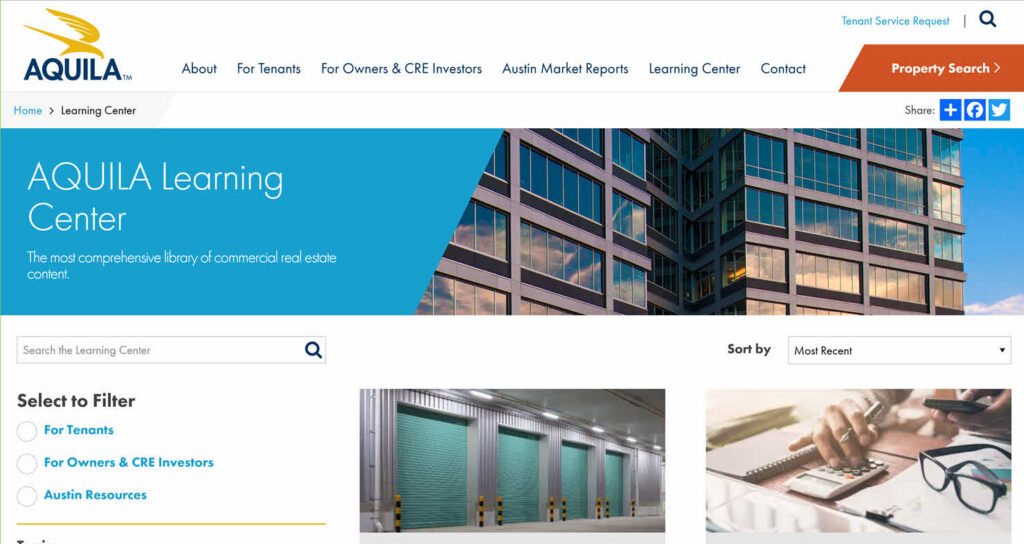
Aquila Commercial is documented by Marcus Sheridan in his book Endless Customers as a true success story of implementing the same Knowledge Centre methodology.
Project
Knowledge Centre + Big 5 Articles + Video (published in-house, two articles and one video per week)
Written by Mark Reynolds, The Knowledge Centre Guy
At a Glance
| Company | Aquila Commercial, a commercial real estate firm in Austin, Texas |
| Who led it | Kendall Guinn (Chief Marketing Officer), with buy-in from co-founders Bart Matheney and Jon Wheless |
| Industry | Commercial real estate (B2B) |
| Team | Small startup, founded in 2006, competing against far larger national firms |
| Problem | Stuck as a local underdog. Stagnant web traffic. Almost zero quality leads coming through the website |
| What they did | Built a body of genuinely helpful content answering every buyer question about buying, leasing and renting commercial property in Austin |
| Result | 1,050% increase in web traffic. 2,909% increase in first-page keywords. 11,350% increase in leads. Around 200 leads a month and 111 customers closed |
| Source | Documented by Marcus Sheridan in the Endless Customers book. This is not one of my clients (I’m The Knowledge Centre Guy). I’m a Certified Endless Customers Partner, trained by Marcus Sheridan and his team to deliver this exact methodology. I’m showing you what the same approach has done for real businesses in the USA and the UK, so you can decide for yourself. |
Want the bit that should stop you in your tracks?
A small local startup, up against national giants who were busy buying up rivals left and right, grew its website traffic by 1,050%. Its leads went up by 11,350%.
That’s not a typo. Eleven thousand percent.
And here’s what I really want you to notice. They didn’t do it with a bigger budget. Not with a bigger team. Not with some clever ad blitz. They did it by becoming the most helpful, most trusted voice in their market.
That’s the whole story. Let me walk you through it properly.
The Startup That Refused to Stay Small
Ever bought a home? Then you know the feeling. The stacks of paperwork. The jargon flying at you. The quiet terror of signing something you don’t fully understand.
Now multiply that by four. That’s what it feels like to buy commercial property for your own business.
Aquila Commercial understood this better than anyone. They’re a commercial real estate firm in Austin, serving property owners, investors, developers and tenants. They started in 2006 as a scrappy local startup. And from day one, they were swimming against the tide.
“We’ve always tried to look at deals a little differently than some of our competitors,” explained co-founder Bart Matheney. “Our competitors are buying up other competitors, and we’re trying to compete, even though we’re just a local startup.”
So here’s the question every underdog has to answer. When you can’t outspend Goliath, how on earth do you beat him?
Aquila knew their one real edge. They were local. They knew Austin better than anyone. They even said so right across the top of their website. “No one knows Austin better.”
But knowing it and proving it to buyers? Two very different things. (More on that in a second.)
The Problem Wasn’t Visibility. It Was Trust.
Here’s where most small businesses get stuck. Aquila was no exception.
The external problem was simple and painful. Their website traffic had been flat for years. Just under 2,000 organic visits a month, going nowhere. And the leads? “Before, we were getting zero quality leads through our website,” said CMO Kendall Guinn.
Zero. Quality. Leads.
The internal problem ran deeper. They knew they were good. They knew nobody understood the Austin market like they did. But being the best-kept secret in your market is a special kind of frustrating. You watch bigger, less local firms win the deals that should have been yours. Simply because buyers found them first. (If that makes your stomach tighten a little, you’re not alone. It’s the single most common feeling I hear from ambitious business owners.)
And the deeper unfairness? Think about what that actually is. A hardworking local firm that genuinely knows its market better than anyone, losing business to a giant purely because the giant has a bigger marketing department. That isn’t right. And here’s the thing. It doesn’t have to be that way.
The Shift. Becoming the Best Teacher in Their Market
So how did a local underdog turn it around?
Kendall had been quietly following Marcus Sheridan’s work for years. The keynotes, the podcast, the YouTube videos. She was, in her own words, a self-confessed “fangirl.”
She’d already worked out what the rest of the company hadn’t yet seen. The way to beat the giants was to answer every single question a buyer had about commercial property in Austin. Honestly. Clearly. In plain English, not “legalese.”
This is the methodology now known as Endless Customers (formerly ‘They Ask, You Answer’) by Marcus Sheridan. It’s the exact proven methodology every Knowledge Centre I build is based on. And the idea behind it is beautifully simple. Your buyers have questions. They want to buy from people they trust. And the business that teaches best wins.
Here’s the bit I really want you to notice, though.
The real engine of this whole approach is the articles. Not a fancy website. Not a shiny new logo. The articles. The depth of them. The honesty in them. And the way they’re written and structured so buyers, Google and AI tools like ChatGPT can all find them and trust them.
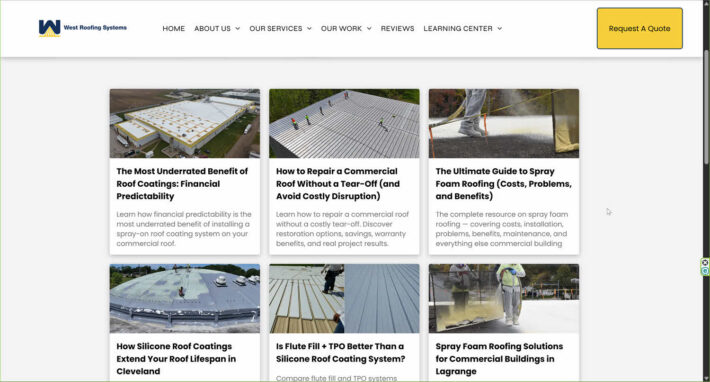
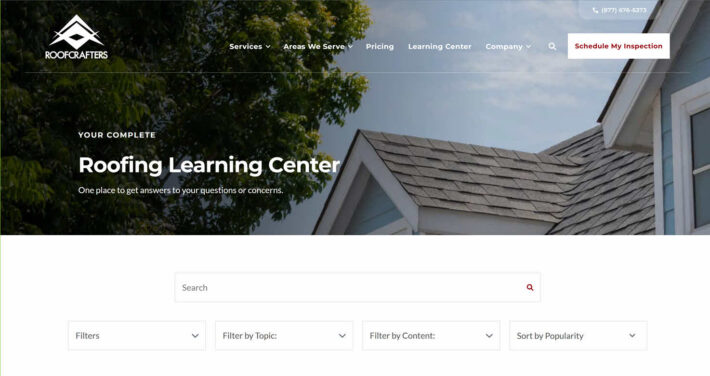
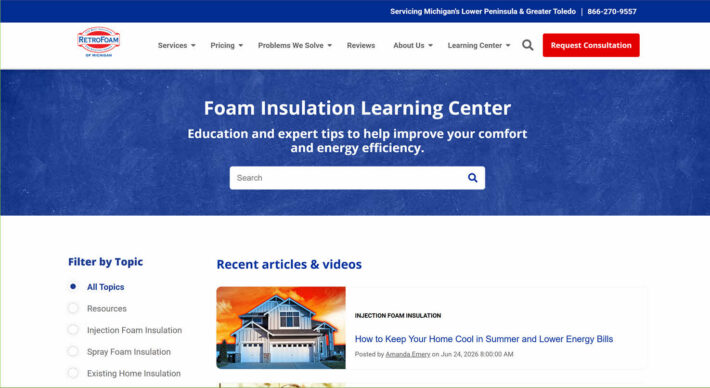
A Knowledge Centre is the home for those articles. It’s a dedicated section of your website, kept completely separate from your blog, that houses your Big 5 articles. The ones that answer your buyers’ real buying questions in depth. Cost. Problems. Comparisons. Reviews. And “best of” lists.
Why keep it separate from the blog? Because they do two completely different jobs.
Your blog talks about what you want to say. Company news. Opinions. Events. It catches people early.
Your Knowledge Centre answers what your buyer needs to know to make a decision. Costs. Fears. Comparisons. It teaches the things that actually drive a sale.
Aquila got it. But there was a catch. (There nearly always is.)
The Elephant in the Room. Getting Everyone Else to Believe
Be honest with yourself for a second. The success stories always look smooth from the outside, don’t they? They never are.
Kendall believed. The rest of the company? Not so much.
“When the idea was first presented to us, I was definitely hesitant,” admitted co-founder Jon Wheless. “I had done our sales process one way my whole career and it seemed to be working. I thought, ‘Why change something that isn’t broke?’ Over time, I was proved wrong.”
That’s the elephant in the room with this methodology. It only works when the whole business commits. The owner who thinks “we’re different.” The sales team who reckon the old way is fine. The quiet resistance that kills a thousand good ideas before they ever get going.
Kendall didn’t bulldoze it. She brought Marcus in for a one-day workshop. “Almost overnight we saw people in our company change,” she said. “People really got it. Everyone was on board.”
And here’s her single most important piece of advice. The one I’d underline twice.
“My advice for people considering this is to really go all in… You need to go all in or you’re not going to see the success it could bring you.”
She’s right. And now I have to be straight with you, using what we call the Law of the Coin. Both sides.
One side of the coin. The success stories are real. Aquila is proof. So are the others in Marcus’s book.
The other side. For every Aquila, there are countless businesses who try this themselves, half commit, run out of steam at eight half-finished articles, and quietly give up. Not because the methodology failed them. Because doing it properly, to the standard that actually wins, is harder and slower than it looks from the outside. (I’ve watched it happen more times than I’d like to admit.)
Let that sink in. The difference between the businesses that win and the ones that don’t usually isn’t talent or budget. It’s whether they finish. That’s exactly the gap I exist to close. More on that shortly.
The Results Spoke for Themselves
So what actually happened once Aquila committed and started publishing?
Things moved fast. Faster than Jon the sceptic can have expected, reading between the lines of how quickly he changed his tune.
The numbers:
- Web traffic up 1,050%. From under 2,000 organic visits a month to over 23,000 at their peak.
- First-page keywords up 2,909%. Meaning when buyers searched, Aquila showed up.
- Leads up 11,350%. From zero quality leads to around 200 a month.
- 111 customers closed, with nearly 400,000 website sessions and over 4,000 contacts made.
But the number that tells the real story is the one Kendall almost mentioned in passing.
“Today, we get two to four quality leads per week. And those leads are coming to us having already read a ton of our content.”
Read that last line again. The leads arrived already trusting them. Already half-sold. The content did the convincing before anyone picked up the phone.
Think about what that actually is. It’s a salesperson who never sleeps, never calls in sick, never takes a holiday, and never once asks for a pay rise. Working away on your website at 2am, warming up buyers while you’re tucked up in bed. That’s what a proper Knowledge Centre becomes.
Their video producer, Patrick Morrison, put it perfectly. The content “took a lot of burden off the sales team so they didn’t have to spend so much time answering the same 30 questions over and over.”
And the giants? “We’re the envy of all of our competitors,” said Bart.
The local David didn’t just survive against Goliath. He made Goliath jealous. So ask yourself. In your market, are you the one being envied, or the one doing the envying?
“But We’re Different” (The Trap That Poisons Innovation)
I can almost hear you thinking it.
“Mark, that’s a commercial property firm in Texas. We’re B2B. Or we’re B2C. Or we’re smaller. Or we’re in a regulated industry. Or our product’s too complex. We’re different.”
I need to gently challenge that. Because the “but we’re different” mindset is one of the most expensive beliefs in business. It quietly poisons the waters of business innovation.
Here’s the truth that cuts through all of it. Every business on earth is in the exact same business. The business of trust, and who can earn more of it. Doesn’t matter if you’re a property firm in Austin, an accountant in Aberdeen, or a manufacturer in Manchester.
Boil the whole methodology down to one question. “Will this build more trust with my buyer?”
If being honest about your prices, your problems and how you compare would make a buyer trust you more, then everything else falls into place. (And it nearly always does.)
Don’t believe me? Look at how broadly this works.
A B2B accounting firm made buyers read a “what it’s like to work with us” article and watch a video before booking a call. It weeded out the bargain hunters. Their average sale price climbed over 10% in year one and nearly 40% in year two.
A high-value property investment firm in New Zealand filmed itself grilling developers with brutally tough questions on camera, instead of hiding its “secret sauce.” It became the most listened-to business podcast in the whole country.
A B2B office technology company built an unbiased tool comparing rival manufacturers side by side, with real price ranges, so buyers could decide for themselves. In an industry built on pushy salespeople, they let people buy without ever speaking to one.
Different industries. Different sizes. B2B and B2C. Same principle. Trust.
Technology changes. Google changes. AI changes. But trust is a principle, and principles don’t change. The businesses that bury their head in the sand and refuse to answer their buyers’ hardest questions don’t make those questions disappear. They just hand their buyers straight to a competitor who will answer.
Put it this way. If you don’t do it, other sharks in your market will scrape up the pieces.
I’ll build a Knowledge Centre that transforms any type of business. Because the principle behind it works for any type of business. Including yours.
A Quick Word on the American Names
Noticed the company names sound a bit, well, American?
You’re not wrong. When I was chatting with Marcus Sheridan, he told me this methodology is huge in the USA. They tend to run a few years ahead of us over there. The UK has far fewer businesses following it properly.
Be honest. Does that sound like a problem, or an opportunity? While your UK competitors are still ignoring their buyers’ toughest questions, the door is wide open. Trust doesn’t care which side of the Atlantic you’re on. It works exactly the same in Leeds as it does in Austin.
What This Means for You
Aquila is a brilliant story. But notice the thing I keep coming back to.
They went all in. They paid for a one-day workshop to convert the team. They learned to write the articles, structure them, get them found. And it took a year of consistent publishing before traffic truly took off.
That’s a lot. And most business owners I speak to don’t have a spare year, a willing in-house marketing team, or a self-confessed Marcus Sheridan superfan ready to lead the charge from the inside.
So here’s where I come in.
The case studies in Marcus’s book are the success stories. What they don’t show you is the long, quiet line of businesses who tried it themselves, did it half-heartedly or got the standard wrong, and ended up exactly where they started. Twelve months later. Twenty-four months later. Still nagged by the same project on the same to-do list.
I take Marcus’s proven methodology and I do it for you. To a good speed. And to a standard that genuinely wins. My whole mission has been to build the finest Knowledge Centres anywhere. Marcus provided the methodology. I’ve aimed to go further than even the Knowledge Centres his own agency built in these very case studies. Don’t take my word for it. Compare the articles side by side and decide for yourself.
Now picture this. That strategic project that’s been sitting on your to-do list for years, quietly nagging at you every single week. Handed to a true expert who simply gets it done. The relief of it being off your plate. The confidence of knowing it’s being built right the first time.
You have a gift, and you’re responsible for sharing it with the world. So let’s make it happen.
One last thing worth chewing on. Your buyers are already asking Google and AI tools who to trust in your market. Right now, while you’re reading this. The only question is whether they find your answers, or your competitor’s. Want to see who AI is currently recommending in your industry? Read Is AI Recommending Your Small Business?
So. Is it going to be you? Or the business down the road?
Ready to Talk About Your Buyers?
If any of this landed, let’s have a proper conversation.
Schedule a 30-minute call with me here. We’ll talk about your business, your buyers, and the questions they’re really asking. And whether a Knowledge Centre is the right move for you. No pressure. No jargon.
Not quite ready for a call? No problem. Have a read first.
- What’s a Knowledge Centre? (And is it worth it?)
- Is a Done-for-You Knowledge Centre right for us?
- How much does a Done-for-You Knowledge Centre really cost? (And is it worth it?)
- The 100% Done-for-You Knowledge Centre Service
- See my own Knowledge Centre so you can judge the standard for yourself.
- More about me, Mark Reynolds, one of only 5 official Endless Customers trained partners in the UK.
Project Specifics
-
Knowledge Centre
-
Writing Big 5 Topic Articles
-
Assignment Selling
-
Radical Transparency
-
Search Visibility
-
AI Visibility
-
Buyer Education
-
Lead Generation
-
Trust Building
-
Founder-led