How a Century-Old Insurance Agency Grew 183% Without Spending a Penny on Advertising
Kaitlyn Pintarich was a one-woman marketing department, failing at everything and feeling lost. Then she stopped trying to do it all, hired one person, and started answering the questions her buyers were actually asking. Here is what happened next, and what it means for you.
They did it themselves:
Berry Insurance is documented by Marcus Sheridan in his book Endless Customers as a true success story of implementing the same Knowledge Centre methodology I build for my clients. They are not a client of mine. I am showing you what this approach does when a real business commits to it.
Project
Knowledge Centre + Big 5 Articles (built in-house by a hired content manager and a small team)
Written by Mark Reynolds, The Knowledge Centre Guy
At a Glance
| Company | Berry Insurance, Franklin, Massachusetts (a family-owned agency over 100 years old) |
| Who led it | Kaitlyn Pintarich, President and Co-Owner |
| Industry | Insurance |
| Team | Started roughly half its current size. A genuine small business. |
| Problem | Kaitlyn was a “one-man band”, doing all the marketing herself while running the agency. Unfocused, overwhelmed, and getting nowhere. |
| What they did | Hired their first content manager and committed to the Endless Customers methodology. Answered real buyer questions in depth and used that content in their sales process. |
| Result | 183% business growth. Revenue almost doubled. The team roughly doubled. Now so busy they sometimes turn people away. All organic. No paid advertising. |
| Source | Documented by Marcus Sheridan in Endless Customers and on the Endless Customers podcast (Ep. 134) |
Quick note on whose story this is. Documented by Marcus Sheridan in the Endless Customers book. This is not a client of mine (The Knowledge Centre Guy), but I am one of only five official Endless Customers trained partners in the UK, trained personally by Marcus Sheridan and his team to implement the exact same methodology. I wanted to show you what this approach has done for real companies in the UK and the USA, so you can decide for yourself.
1. She Bought a 100-Year-Old Business and Wanted to Grow It
What happens when you buy a business that’s older than your grandparents?
In 2017, Kaitlyn Pintarich and her husband found out. They bought Berry Insurance and went from employees to owners overnight. Exciting? Absolutely. Also heavier than anyone tells you.
Like most owners, Kaitlyn ended up wearing every hat. One of those hats was marketing. (I’d put money on it being the one that fitted worst.) She wanted the agency to grow. She wanted demand. What she had was a to-do list that never ended and a nagging feeling she was busy without moving an inch forward.
Sound familiar?
2. The Problem Was Costing More Than Time
So what was actually going wrong?
Here is what Kaitlyn was doing for marketing. A bit of social media. A few newsletters. No plan, no focus, no system. In her own words, “I quickly realized that approach was not going to work.”
That is the external problem. Scattered effort, no traction.
But there were two deeper layers underneath, and these are the ones that keep owners awake at night.
The internal problem was that she felt lost and stretched impossibly thin. She was, by her own admission, failing at everything because she was trying to do everything. Every sales conversation was the same. Same questions. Same explanations. Same answers, over and over, all locked inside her team’s heads and never written down anywhere a buyer could find them.
The philosophical problem is the one I see in nearly every business I speak to. A genuinely good business should not lose out simply because it is quieter than the loud, average ones around it. Berry had served people well for a century. None of that was reaching the buyer researching insurance at 10pm on a Tuesday.
Here’s the bit I really want you to notice. That quiet revenue leak does not arrive as a disaster. It arrives as a slow, polite drip of good prospects choosing someone else, because that someone else answered the question first. You barely feel it. That’s exactly why it’s so dangerous.
3. The Guide She Needed (And the One You Need)
So who, or what, turned this around?
Berry’s comeback was built on a specific, proven approach. It is called Endless Customers (formerly They Ask, You Answer) by Marcus Sheridan. This is the methodology my entire Knowledge Centre service is built on. It is not a theory. It is a documented system used by thousands of businesses, and Berry is one of the stories in the book.
The idea is almost embarrassingly simple. Your buyers have questions. They prefer to buy from people they trust. The most helpful teacher in any market wins. So you take the questions buyers genuinely ask, especially the awkward ones about cost, problems and comparisons, and you answer them honestly, in public, in depth.
That is where I come in for businesses on this side of the Atlantic.
I am one of only five official Endless Customers trained partners in the UK, trained personally by Marcus Sheridan and his team. I do not just teach this. I build it. Marcus put it better than I could. “He doesn’t just teach this stuff, he makes it happen.”
Now I’ll be straight with you, because honesty is the whole point of this method. Berry built their content engine in-house, the same way many of the companies in Marcus’s book did. They did the work themselves and got brilliant results. That route is open to you too, and if you’ve got the time and the appetite for it, have a real crack at it.
But here’s what I’ve seen, every single time. The owners who hand me what they’ve already written, having tried to follow the framework alone, are not producing work that’s good enough yet. Not because they aren’t clever. Not because they didn’t try hard. Because there’s a gap between “decent content” and the kind of article that makes a stranger trust you enough to buy. Most people can’t see that gap until they’ve seen the gold standard sitting right next to their own.
4. The Plan Was Simple Enough to Actually Do
Want to know the best part of Berry’s story? There was no magic. There was a system, and you could start it on Monday morning.
Step one. Capture the questions. In their meetings, they started asking the sales team one thing. What did clients ask you this week? Then they wrote those questions down. A library of real buyer questions, built from real conversations.
Step two. Answer them properly. They turned each question into an in-depth article and a video. Not a thin 600-word blog post written to please Google. A genuine, useful answer to a real buying question. And here’s the brave bit. They talked about price, openly, in an industry where everybody hides it. Kaitlyn admitted it felt scary. They did it anyway.
Step three. Use it in the sales process. This is the move that changes everything, and it has a name. Assignment Selling. When a prospect asked a question, the team sent the article or the video before the call. By the time they spoke, the buyer was educated, confident, and often half-decided already.
Now, a quick word on where all that content lived, because this trips up a lot of owners.
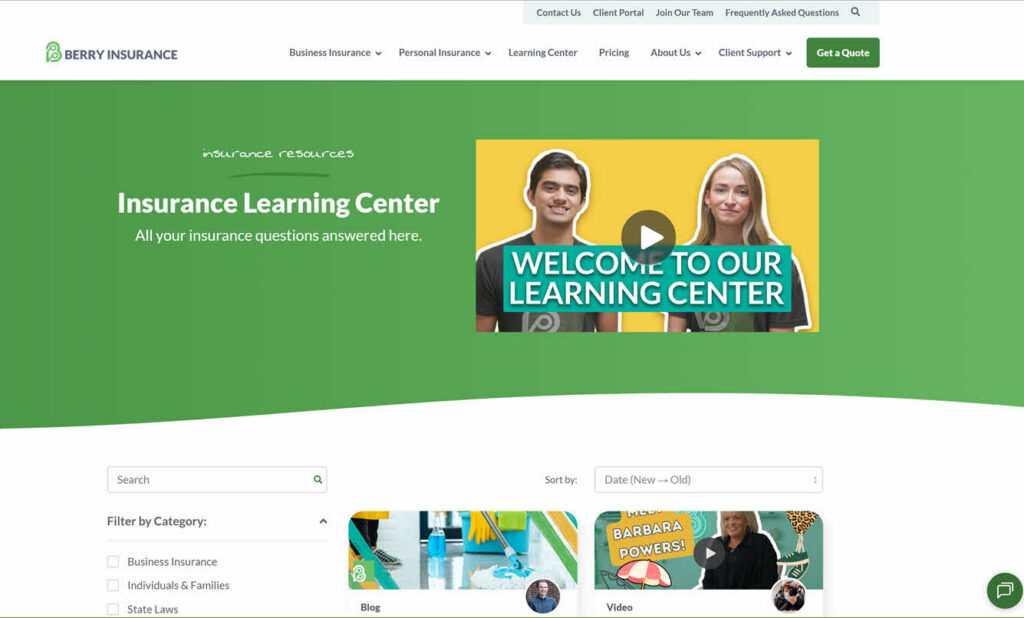
This is not a blog. Your blog and your Knowledge Centre are two completely different things. A blog is for your opinions, your news, your event announcements. It is what your business wants to say, and buyers usually read it early on, if at all. A Knowledge Centre is a separate section of your website with one job. It answers the specific questions a buyer asks when they are deciding whether to spend money. Cost. Problems. Comparisons. Reviews. The best options. The questions that actually move the sale.
And here’s the thing I most want you to take from Berry’s story. The Knowledge Centre itself is just the shop window. The real engine is the articles, and how they’re written. Written to answer a buyer’s exact question better than anyone else in the market. Written so humans trust you, and so Google and ChatGPT learn to recommend you. The Knowledge Centre simply makes all of that easy for a buyer to find.
Think about what that actually is. A brilliant article, sitting on your website, answering a buyer’s question at two in the morning while you’re fast asleep. It’s the hardest-working member of staff you never had to put on the payroll. It never gets bored of the same question, it never books a holiday, and it has never once asked for a Friday off. Let that sink in.
5. The Decision Came Down to Trust, Time, and Letting Go
So when did it actually click for Kaitlyn?
At a conference. She went to Endless Customers Live, came home, and made a decision. “Okay, we’re hiring a content manager. Help me!”
That was not a marketing decision. It was a leadership decision.
What almost stopped her? The usual suspects. Talking about price felt terrifying. Building a marketing team inside an insurance agency felt strange. And there’s always that quiet worry of, what if I spend the money and it doesn’t work?
She moved anyway. Then she did something most leaders skip. She got the whole team to read the book together, so the shift was shared, not barked down from the top. That is how you build momentum that lasts. Be honest, would your team be reading it with you, or rolling their eyes behind your back?
6. The Results Changed How the Business Operates
Let me give you the numbers, because this is where it gets fun.
Berry’s business grew by 183%. In Kaitlyn’s own words, they “almost doubled” their revenue, and the team roughly doubled in size from where they started. Every bit of it organic. “We don’t pay for any advertising,” she said. “Everything comes in through our website, through our content, or through word-of-mouth referrals.”
Read that line again. No ad budget. That’s the dream most owners are quietly chasing.
But the metrics aren’t even my favourite part. Watch what happened to the quality of their leads.
Because they answered the scary questions honestly, prospects started turning up pre-qualified. The wrong-fit people screened themselves out before they ever called, which saved everyone’s time. The right ones had already read an article and were ready to move forward. The sales cycle got shorter. The conversations got better.
And then there’s my favourite moment in the whole story. A prospect read an article written by a team member called Robbie, then reached out and asked, “Can I talk to Robbie?” (Reading between the lines, I’d put money on Robbie having no idea an article with his name on it was out there quietly doing his networking for him.) That’s not a lead. That’s a buyer who already feels like they know your team and trusts them, before a single word is exchanged.
How did they pull all this off? Not by hiring slicker salespeople. Not by being pushier. Just by being more helpful than anyone else in their market.
The result? Berry is now so busy they sometimes have to turn people away. Kaitlyn called it “an interesting problem to have.” It is. It’s also the clearest proof I can hand you that this works.
7. What This Actually Means for a Business Like Yours
So what does any of this mean for you?
Here’s the lesson, stripped of all the noise. You do not need a big team. You do not need an ad budget. You need to answer the questions your buyers are already asking, better than anyone else in your market, and put those answers where they can be found.
Now, I can almost hear the thought forming. “That’s all well and good for an insurance agency, Mark, but we’re different.” Be honest, has it crossed your mind already?
It’s the most common objection I hear. It’s also the one that quietly poisons more ambitious businesses than any competitor ever could. So let me head it off. Bigger or smaller, B2B or B2C, product or service, it genuinely does not matter. Here’s why. Every business on earth is in the exact same business. The business of trust, and who can earn more of it. So boil this whole system down to one question. Will this make my buyers trust me more? If the answer is yes, and it nearly always is, then everything else is just detail. I build transformative Knowledge Centres for every kind of business, not only insurance agencies in Massachusetts.
Now let me be fair, the way this method demands, and show you both sides of the coin.
The hard side first. This is not a quick win. Berry did not flip a switch. As Kaitlyn put it, “It’s a commitment, and it’s not something that you can do on a quarterly basis.” It’s a cultural shift. Treat content like a one-off campaign and you’ll get campaign results, which is to say, almost nothing. That’s the honest cost, and I’d rather you knew it now than after you’d started.
The other side of the coin? That is exactly why this is such a rare opportunity. Most of your competitors won’t have the patience or the nerve. So the gap is wide open, and the first business to fill it well wins the trust, and the recommendations, for years. As I tell my clients, if you don’t do it, other sharks in your market will scrape up the pieces.
A word for the UK reader, because Berry is obviously an American business, and that can feel a little distant. When I was chatting with Marcus, he made a point that stuck with me. This methodology is enormous in the USA. They tend to be a few years ahead of us. Far fewer UK businesses are using it well, which means the opportunity here is genuinely bigger, not smaller. Trust is universal. Whether your buyer is in Birmingham or Boston, they want the same thing. An honest expert who answers their questions before asking for the sale.
And there’s a newer reason this matters more than ever. Your buyers are no longer just asking Google. They’re asking ChatGPT and other AI tools who to trust in your industry. Those tools learn from genuinely useful, expert content, the exact kind Berry built. The businesses that answer well today are the ones AI will recommend tomorrow. (Want to see where you currently stand? Read Is AI Recommending Your Small Business? for a free 15-minute check.)
One last point of honesty. The Knowledge Centres in Marcus’s book, Berry’s included, were built by capable in-house teams and by Marcus’s own agency. They work. But I took the same methodology and aimed higher. The best Knowledge Centres in the world, with articles written to a standard I believe goes beyond what you’ll see in those examples. I’m not asking you to take my word for it. Compare the articles yourself. Take a look at my own Knowledge Centre and judge.
Because here’s what I genuinely believe about your business. You have a gift, and you are responsible for sharing it with the world. Make it happen.
8. Let’s Talk About Whether This Is Right for You
So where does that leave you?
Kaitlyn was overwhelmed, wore too many hats, and felt like she was failing. She’s now turning customers away. The difference wasn’t a bigger budget. It was a decision to start, and the focus to see it through.
You’ve got two routes from here, and I want to be straight about both.
You can build it yourself, the way Berry did. Study the Endless Customers methodology, protect 10 to 15 real hours a week, and commit for the long haul. If that genuinely suits you, go for it.
Or you can hand the whole thing to someone who’s built more Knowledge Centres, across more UK industries, than anyone else, and have it done properly the first time. That’s the 100% Done-for-You Knowledge Centre service. Imagine that feeling. The moment you finally hand it to an expert who simply gets it done, and you’re free to get on with running your business.
If you’re weighing it up, these are worth your time.
- What is a Knowledge Centre? (And is it worth it?)
- Is a Done-for-You Knowledge Centre right for us?
- How Much Does a Done-for-You Knowledge Centre Really Cost? (And is it worth it?)
- More about me, Mark Reynolds
Whichever way you’re leaning, the smartest next step is a proper conversation.
Book a free 30-minute call with me
Book a call and we’ll talk about your business, your buyers, and the questions they’re really asking, and whether a Knowledge Centre is the right move for you. No pressure, no jargon. And if it’s not the right fit for you, I’ll tell you straight.
The businesses winning in your market over the next decade will be the ones brave enough to answer the questions everyone else avoids. Berry did it. So here’s the only question left. When a buyer asks Google or ChatGPT who to trust in your market, do they find your answer, or the business down the road?
Project Specifics
-
Knowledge Centre
-
Writing Big 5 Topic Articles
-
Assignment Selling
-
Sales Enablement
-
Lead Generation
-
Search Visibility
-
Buyer Education
-
Family-Owned